
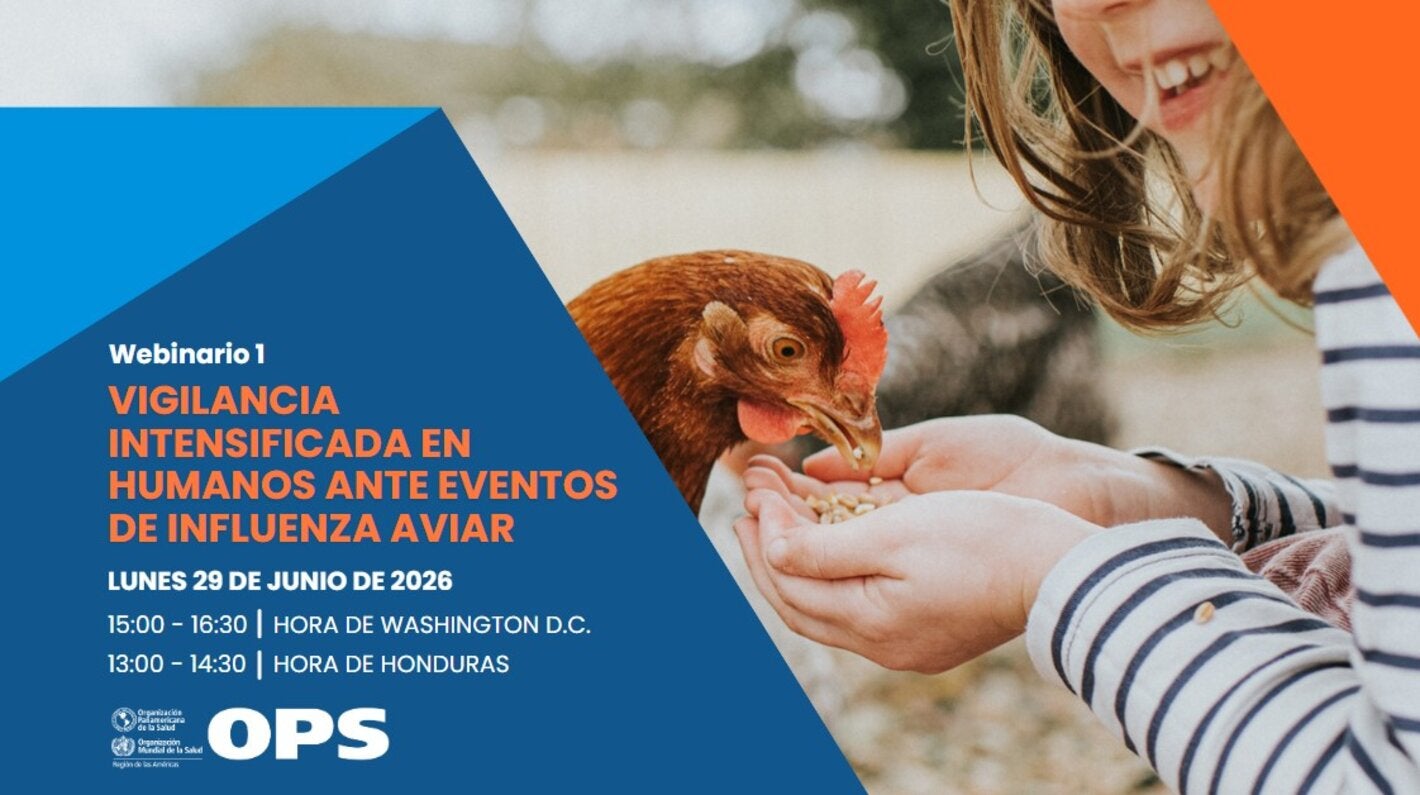
Washington, D.C., June 29, 2026 (PAHO) – The Pan American Health Organization (PAHO), in collaboration with the Honduran Ministry of Health (SESAL) and the National Service for Agrifood Health and Safety (SENASA), held a virtual seminar for the national surveillance, rapid response, and clinical care teams, with the aim of strengthening national capacities for the early detection of human cases of avian influenza A(H5N1).
The seminar was organized following the confirmation of outbreaks of highly pathogenic avian influenza in wild birds and at a commercial poultry farm in Honduras. In response, national authorities activated surveillance and response mechanisms under the One Health approach, ensuring close coordination between the human and animal health sectors.
The program covered four main topics: the epidemiological situation of avian influenza in the Americas and in Honduras; enhanced surveillance strategies for populations at occupational risk of exposure; laboratory surveillance for zoonotic influenza; and clinical management, prevention, and control measures in healthcare facilities.
Presentations were delivered by PAHO regional experts together with technical teams from SESAL and SENASA. As part of the session, national authorities presented the country’s epidemiological situation, including active surveillance activities conducted in communities and commercial farms, as well as the follow-up of exposed individuals in affected areas. To date, Honduras has not reported any confirmed human cases of avian influenza
Among the key recommendations, speakers emphasized the importance of implementing enhanced surveillance in healthcare facilities, systematically assessing patients for exposure to birds or potentially contaminated environments, actively monitor exposed individuals for at least 14 days following their last exposure, and initiate antiviral treatment early in cases of clinical suspicion. The importance of implementing infection prevention and control measures was also highlighted, including the appropriate use of personal protective equipment (PPE) and environmental cleaning and disinfection in healthcare facilities.
The training session was attended by epidemiologists, hospital directors, microbiologists, and staff from health regions, social security agencies, and private healthcare institutions across the country.
This activity is part of a series of seminars organized by PAHO to support Honduras in its preparedness and response to the circulation of highly pathogenic avian influenza. The second session, dedicated to surveillance and response in animals and wildlife, is available at the following link: https://www.paho.org/en/events/surveillance-and-response-avian-influenza-animals-and-wildlife