
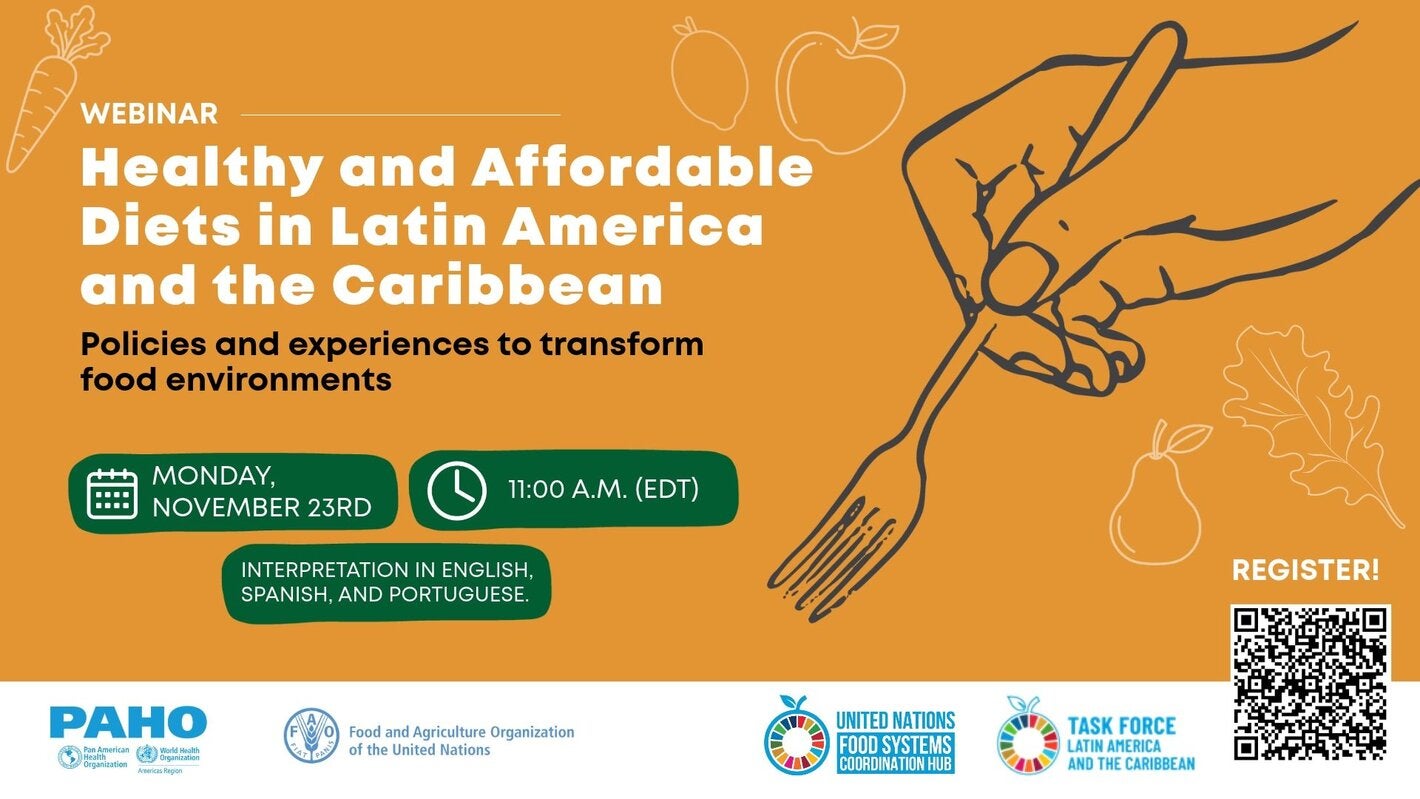
Join us on Monday, November 23rd, 2026, at 11:00 a.m. (Washington, D.C. time, or EST) on the webinar "Healthy and Affordable Diets in Latin America and the Caribbean: Policies and Experiences to Transform Food Environments". The webinar aims to combine presentations on regional evidence and policy guidance with concrete examples from different countries and cities, and to facilitate exchange among the health, agriculture/food, and education sectors on measures that can make healthy diets more accessible and affordable.
Objectives of the webinar:
- Present the state of food security and nutrition in Latin America and the Caribbean, emphasizing the cost and affordability of healthy diets and the distinctive features observed in the Caribbean.
- Promote a better understanding of the factors that determine the cost and access to healthy diets, helping overcome the perception that a healthy diet is necessarily more expensive.
- Present policy frameworks and instruments that can contribute to improving food environments and access to healthy, nutritious, sustainable and affordable foods.
- Facilitate the exchange of experiences and good practices among countries and cities, including policies on school feeding programs and public procurement, dietary guidelines, labeling and other interventions on food environments.
- Strengthen the intersectoral dialogue and cooperation among the health, agriculture/food and education sectors to support the implementation of national roadmaps for food systems transformation.
How to participate
- DATE: Monday, November 23rd, 2026
- TIME: 11:00 a.m. (Washington, D.C. time or EST) [Check at the end of the page the time in other cities]
- LANGUAGES: Spanish and English, with simultaneous interpretation in those languages
- REGISTER: https://paho-org.zoom.us/webinar/register/WN_xewCcBokSTyhEx_4-r3jiw#/registration
Agenda
Moderator: Lesly Vejar, PAHO
- Opening: Food Systems Transformation and access to affordable and healthy diets
- Overview of Food Security and Nutrition in Latin America and the Caribbean: trends, cost and affordability of healthy diets, with an emphasis on the Caribbean
- From challenges to policy responses: Policies to promote healthy food environments and improve access to healthy and affordable diets
- Roundtable: Experiences and good practices to improve access to healthy and affordable diets
- Brazil – National School Feeding Program (PNAE) and public procurement
- Mexico – Comparison of the cost of a diet aligned with the Healthy and Sustainable Dietary Guidelines, and the current diet
- Experience with front-of-package labeling
- Brazil – Taxes on foods and ultra-processed products across their respective production chains
- A city in the “FAO Alimentas Ciudades” (CISA) Network
- An experience from the Caribbean on implementing healthy eating policies in school settings
- Question and Answer session with participants
- Closing
Context
Latin America and the Caribbean have recently made progress on food security. The 2025 Regional Overview of Food Security and Nutrition indicates that hunger and food insecurity have declined for four consecutive years. Nevertheless, these advances coexist with significant inequalities and multiple forms of malnutrition. In addition, in all three subregions of Latin America and the Caribbean, the cost of a healthy diet is higher compared to the global average, continuing to limit access for a significant portion of the population.
These challenges vary considerably across countries and subregions and cannot be interpreted homogenously. At the same time, it is important to broaden understanding of the relationship between healthy eating and costs. The perception that a healthy diet is necessarily more expensive can obscure how current consumption patterns and food environments shape household decisions. Experiences and analyses developed in some countries of the region highlight the importance of comparing the cost of current diets – including high consumption of processed and ultra-processed foods – against healthy and sustainable diets aligned with national food-based dietary guides. Therefore, improving access to healthy and affordable diets requires addressing food environments and combining different policy instruments. National food-based dietary guidelines, front-of-package food labeling, public procurement and food services, school feeding programs, food supply and marketing policies, fiscal policies and city-led interventions are, among others, complementary entry points for facilitating healthy food choices and strengthening sustainable agrifood systems.
Cities play a particularly relevant role here. Urban and territorial policies can connect local food supply with demand, strengthen markets and distribution channels, guide public procurement and create environments that facilitate physical and economic access to healthy foods. Additionally, school settings are a strategic area for intervention. The Regional Guidelines on Healthy Eating and Physical Activity Policies in School Settings, developed by PAHO and OAS, offer a framework for countries to design, implement, monitor and evaluate intersectoral policies, including measures related to school feeding programs, public procurement, availability of healthy foods and regulation of processed and ultra-processed foods.
Time in other cities
- 7:00 am – Los Angeles, Vancouver.
- 8:00 a.m. – Belmopan, Guatemala City, Mexico City, Managua, San Salvador, San Jose (Costa Rica), Tegucigalpa.
- 9:00 a.m. - Bogota, Kingston, Lima, Panama City, Quito
- 10:00 a.m. - Bridgetown, Caracas, Castries, Georgetown, Havana, La Paz, Nassau, Ottawa, Port of Spain, Port-au-Prince, San Juan, Santo Domingo, Saint George's, Saint John's (Antigua), Washington D.C.
- 11:00 am – Asunción, Buenos Aires, Brasília, Montevideo, Paramaribo, Santiago.
- 4:00 p.m. – Geneva, Madrid.
For other cities, check the local times in the following link.