
Organization
This technical webinar is co-organized by the Pan American Health Organization (PAHO) and the World Meteorological Organization (WMO). The event conducts a singular, comprehensive, two-hour session designed to drive immediate, evidence-based anticipatory action across the region.
Background and rationale
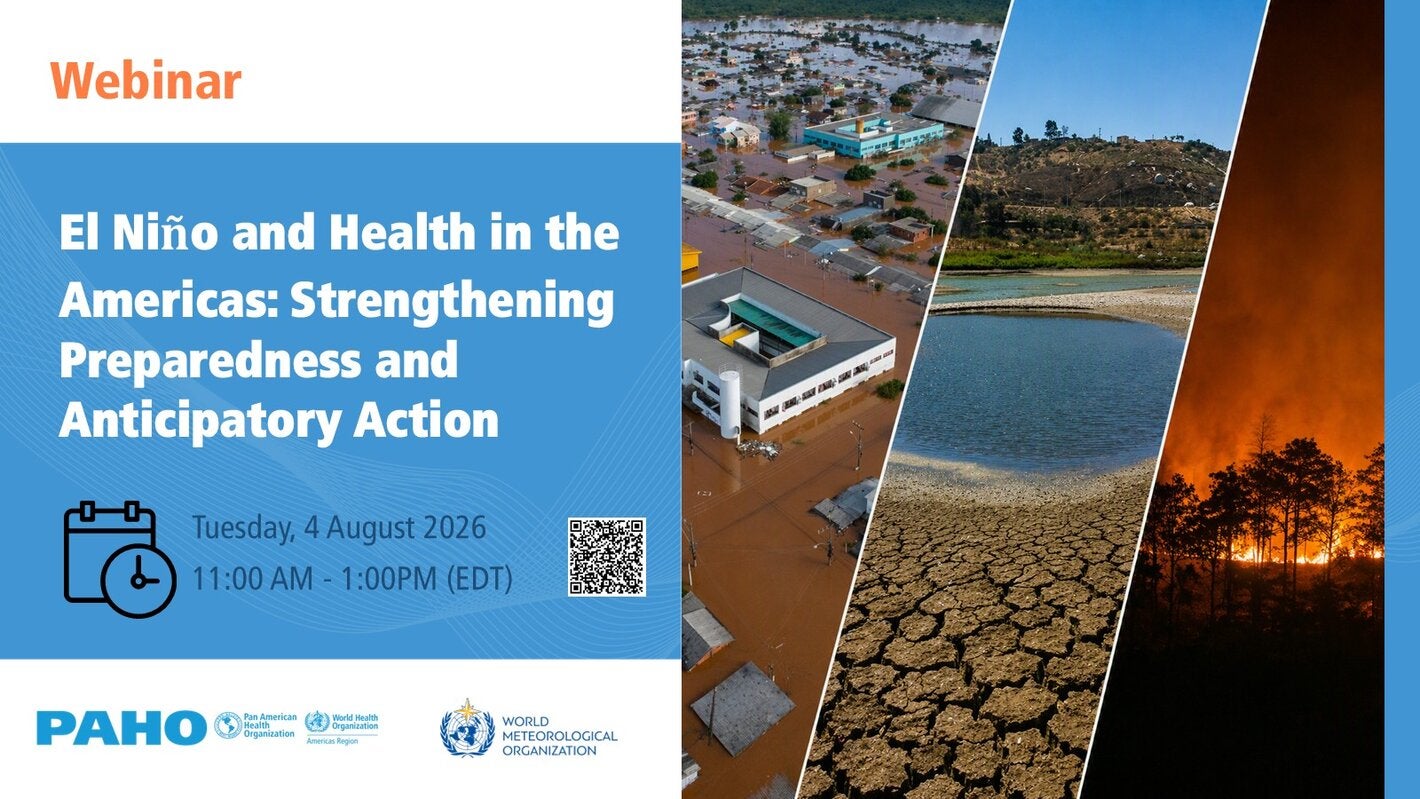
The El Niño–Southern Oscillation (ENSO) remains a dominant driver of year-to-year climate variability, profoundly altering rainfall and temperature patterns across the Americas. These shifts intensify climate-sensitive hazards, including extreme heatwaves, prolonged droughts, intense rainfall, flooding, and wildfires. Critically, these environmental changes alter the geographic distribution and burden of vector-, water-, and food-borne diseases. The WMO confirms that El Niño conditions have developed in the tropical Pacific and are forecast to strengthen rapidly over the coming months, increasing the likelihood of heatwaves, droughts, heavy rainfall and other extreme weather events in many parts of the world.
That outlook must be translated into localized public health measures before climate-sensitive hazards escalate into health emergencies. WMO’s capacity in climate monitoring and forecasting complements PAHO’s mandate to strengthen health emergency preparedness, readiness, response, and recovery; together they convert a seasonal forecast into operational readiness at the country level — the pre-positioning of plans, supplies, surveillance triggers, and trained personnel ahead of impact.
Building on past joint initiatives, this consolidated webinar links meteorological intelligence to health-sector decision-making, so that ministries of health, national meteorological and hydrological services, and disaster management authorities act on the forecast rather than on the impact.
Objectives
The webinar has 4 main goals:
- Provide Synchronized Updates: Deliver current regional climate outlooks alongside evolving public health risk assessments.
- Strengthen Disease Surveillance & Heat Stress: Enhance regional understanding of biological hazards, focusing heavily on arboviral risks accelerated by climate anomalies.
- Promote Multi-Sectoral Readiness: Equitize actionable, evidence-based public health interventions across climate, health, and disaster management networks.
- Foster Regional Collaboration: Drive closer coordination between National Meteorological and Hydrological Services (NMHSs), Ministries of Health, and regional disaster management bodies.
Participation
- DATE: Tuesday, 4 August 2026
- LANGUAGES: English, Spanish
- TIME: 11:00 AM - 1:00 PM (ET, Washington, Ottawa, Chile, Bolivia)
- OTHER TIME ZONES: Buenos Aires, Brasilia (12:00 PM), Mexico City (9:00 AM), Bogota, Kingston, Lima, Panama City (10:00 AM).
- PLATFORM: ZOOM (with registration)

Agenda
Topic
Moderator
Daniel Buss. Director, Climate Change and Environmental Determinants of Health Unit, PAHO
Opening session and framing
Gerry Eijkemans. Director, Department of Social and Environmental Determinants for Health Equity, PAHO
Julián Báez. Director, WMO Regional Office for the Americas
El Niño: projections for the Americas
Bárbara Tapia Cortés. WMO Regional Office for North America, Central America and the Caribbean
Public Health Situational Analysis: Risks, Preparedness and Response
Rajkrishna Ravikumar. Epidemic intelligence and GIS analysis consultant, PAHO
Thais Dos Santos. Advisor on Surveillance and Control of Arboviral Diseases, PAHO
Zuhelen Padilla. Climate Change and Health Consultant, PAHO
Moderation: Álex Camacho. Advisor on Emergency Preparedness and Risk Reduction, PAHO
Country perspectives: Public Health Preparedness, Response and Priority Gaps
Gustavo dos Santos Souza. Department of Environmental Health Surveillance and Workers’ Health, Ministry of Health, Brazil
Herland Gallegos. National Service of Meteorology and Hydrology, Bolivia
Jennifer Esther Yanes Arriaza. Technical Manager, Environmental Health Directorate, Ministry of Health, El Salvador
Georgiana Gordon-Strachan. Director, Tropical Metabolism Research Unit; Executive Director, Regional Centre for SIDS, Lancet Countdown Health and Climate Change, University of the West Indies, Jamaica
Moderation: Celso Bambaren. Unit Chief, Country Preparedness and International Health Regulations, PAHO
Interactive Q&A and Closing Remarks
Daniel Buss. Unit Chief, Climate Change and Environmental Determinants of Health Unit, PAHO