
Participation
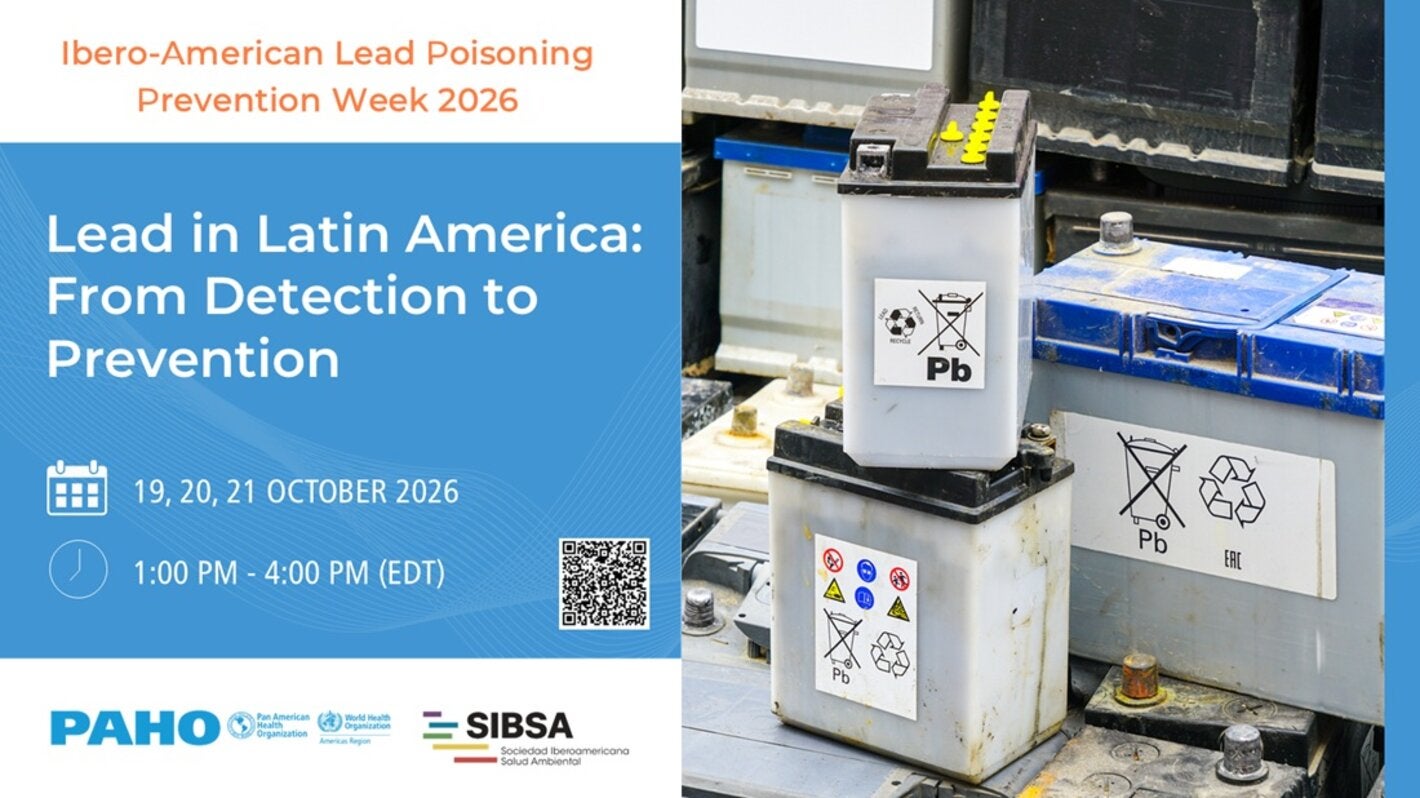
- DATE: 19, 20 and 21 October, 2026.
- TIME: 1:00 p.m. – 4:30 p.m. (EDT; Washington, D.C., Bahamas, Dominican Republic, Haiti, and Venezuela).
- OTHER TIME ZONES: 11:00 a.m. – 2:00 p.m.: Central America. 12:00 p.m. – 3:00 p.m.: Colombia, Ecuador, Jamaica, Peru. 2:00 p.m. – 5:00 p.m.: Argentina, Brasília, Chile, Suriname, Uruguay.
- PLATFORM: ZOOM (with registration).
- LANGUAGES: English and Spanish.
Organize
Pan American Health Organization (PAHO) and the Ibero-American Society of Environmental Health (SIBSA), with the support of the World Health Organization (WHO).
Context
The fourteenth International Lead Poisoning Prevention Week will take place from 18 to 24 October 2026. This year’s campaign theme, From Detection to Prevention, highlights the fact that lead poisoning is often invisible, can arise from multiple sources, and must be identified before action can be taken to protect health, particularly the health of children.
Ibero-American Week
Latin America is not immune to the presence of lead as a global environmental contaminant. However, the region has specific characteristics regarding the sources and contexts of human exposure. Industrial, mining, and artisanal activities, both formal and informal, constitute significant sources of exposure and create diverse risk scenarios shaped by the productive, social, and environmental characteristics of each territory.
Despite the importance of this issue, research remains limited in terms of adequately assessing and characterizing lead exposure, particularly among children. This knowledge gap translates into insufficient capacity to identify exposed populations in a timely manner, ensure appropriate case management, and develop effective strategies for the prevention and control of lead poisoning.
To gain a better understanding of the activities being carried out across the Region of the Americas, a series of virtual seminars is being organized during International Lead Poisoning Prevention Week under the theme Lead in Latin America: From Detection to Prevention, with the objective of raising awareness about the health risks associated with lead exposure and promoting the timely identification of exposure sources, as well as the implementation of effective preventive measures, with a particular emphasis on protecting children.
Agenda
Topic
DAY 1. MONDAY, OCTOBER 19, 2026
Lead in Latin America: from detection to prevention
Opening
Moderator: Luis Francisco Sánchez. Regional Advisor on Chemical Safety, PAHO/WHO
Daniel Buss. Climate Change and Environmental Determinants of Health Unit, PAHO
Marie Noel Brunne Drisse. Children's Environmental Health, Department of Environment, Climate Change and Health, WHO
Susana García. Ibero-American Society of Environmental Health (SIBSA)
Fernando Díaz Barriga. PAHO/WHO Collaborating Centre, Autonomous University of San Luis Potosí, Mexico
Mauricio León. PAHO/WHO Collaborating Centre, Autonomous University of San Luis Potosí - Mexico: Good practices platform to prevent lead exposure
Questions and answers session
Perspectives from Uruguay: The relevance of clinical practice in children's environmental and occupational health
Presenter and moderator: Amalia Laborde. Academic Unit of Toxicology, Hospital de Clínicas
Nancy De León. Academic Unit of Toxicology, Faculty of Medicine, UDELAR: Lead contamination in pregnant women treated at the Hospital de Clínicas
Florencia del Cioppo. Academic Unit of Toxicology, Faculty of Medicine, UDELAR: Protocol for the surveillance and treatment of occupational exposure to inorganic lead
Lorena Carro. Academic Unit of Toxicology, Faculty of Medicine, UDELAR: Lead exposure in the Pediatric Environmental Health Unit in Uruguay (2011-2024)
Lorena Carro. Academic Unit of Toxicology, Hospital de Clínicas: Occupational and environmental lead exposure linked to shooting practice in Uruguay
Questions and answers session
Perspectives from Argentina: The importance of assessing environmental matrices
Moderator: Luciana Antolini. Health Directorate, ACUMAR
Armando Chamorro. CIH Soluciones Ambientales SRL: Identification and control of lead in environmental liabilities. Measurements in water, soil, paint, etc. Experiences in the USA and Argentina. Health risks associated with the redevelopment of abandoned industrial sites in Greater Buenos Aires: implications for children's health in contexts of social vulnerability
Lara Romina Buthet. IAPCH, UNVM: Socio-environmental Health Project: monitoring of lead in soil and air matrices and in sentinel animals in a town in Córdoba, Argentina
Patricio Carmona. Health Directorate, ACUMAR: assessment using portable X-ray fluorescence and its relevance to public health
Alejandro Nadra. Institute of Biosciences, Biotechnology and Translational Biology (iB3), FCEyN-UBA: PlomBOX: a low-cost, open-source device for detecting lead in drinking water
Luciana Antolini. Health Directorate, ACUMAR: Assessment of heavy metals in surface soil in Barrio Magaldi: source identification and environmental risk for children
Questions and answers session
Perspectives from Ecuador
Presenter and moderator: Judith Venegas Calderón. Drug and Toxicology Information Center (CIMET), Central University of Ecuador, Faculty of Chemical Sciences
Marlon Israel Lema Salazar. Drug and Toxicology Information Center (CIMET), Central University of Ecuador, Faculty of Chemical Sciences: Lead biomonitoring in Ecuador: The urgent need for a national surveillance system
Doménica Anahí López Marcalla. Drug and Toxicology Information Center (CIMET), Central University of Ecuador, Faculty of Chemical Sciences: Toxicological Risk Assessment of Lead in Artisanal Ceramics in Ecuador
Alison Pamela Taipe Yuccha. Drug and Toxicology Information Center (CIMET), Central University of Ecuador, Faculty of Chemical Sciences: Records of lead contamination in food in Ecuador: analysis and regulatory challenges
María José Moncayo Albuja. Drug and Toxicology Information Center (CIMET), Central University of Ecuador, Faculty of Chemical Sciences: The invisible danger of lead paint in Ecuador: regulatory analysis, market control and challenges in health surveillance
Anahí Criollo. Drug and Toxicology Information Center (CIMET), Central University of Ecuador, Faculty of Chemical Sciences: From regulation to practice: availability of chelating agents and their impact on the clinical management of lead poisoning in Ecuador
Andrés Sebastián Bonilla Salme. Drug and Toxicology Information Center (CIMET), Central University of Ecuador, Faculty of Chemical Sciences: Study of neurodegenerative diseases related to chronic occupational lead poisoning
Questions and answers session
DAY 2. TUESDAY, OCTOBER 20, 2026
The importance of biomonitoring
Moderator: Edda Villaamil. Ibero-American Society of Environmental Health (SIBSA)
José María Ordóñez (Spain). SIBSA: Blood lead surveillance: all children or only those exposed? Using emissions in Spain to target child biomonitoring.
Ignacio Bressán (Dominican Republic). Department of Bioanalytical Chemistry, Referencia Laboratorio Clínico: Blood lead biomonitoring using routine data from a clinical laboratory in the Dominican Republic
Liliana Disalvo (Argentina). Institute for Pediatric Development and Research (IDIP), Hospital de Niños de La Plata: Environmental lead exposure in healthy children in La Plata, Argentina: A synthesis of studies by the Institute for Pediatric Development and Research (IDIP)
Gabriel Côrtes (Brazil). Vital Strategies, Brazil Office: Blood lead biomonitoring in Brazil: literature review and knowledge gaps, 2000–2025.
Elizabeth Plasencia (Venezuela). Master's Program in Analytical Toxicology, Faculty of Health Sciences, University of Carabobo: Lead levels in blood and breast milk: their relationship with lipid peroxidation and risk factors in breastfeeding mothers in Carabobo State, Venezuela.
José Miguel Mora Humara (Mexico). PAHO/WHO Collaborating Centre on Children's Environmental Health, Autonomous University of San Luis Potosí: Constant monitoring in the face of a persistent threat. The role of bioindicators in assessing lead exposure, effects and risk.
Daniela Alejandra Curvale (Argentina). Faculty of Health Sciences, National University of San Luis: Lead biomonitoring in the lakeshore areas of Cruz de Piedra and La Florida: assessment of the risk of trophic transfer to environmental health.
Questions and answers session
Break
5-minute break.
Keynote lecture
Francisco Sánchez Otero. Regional Advisor on Chemical Safety, PAHO/WHO
The costs of inaction on childhood lead exposure: a look at the health problem in Latin America and the Caribbean.
Questions and answers session
Perspectives from Argentina: From detection to prevention
Moderator: Francisco Sánchez Otero. PAHO/WHO
María Fernanda Mera. Center of Excellence in Products and Processes, CEPROCOR, Córdoba: Childhood lead exposure in Córdoba, Argentina. Guideline values for lead in soil. Risk estimation using the IEUBK model. Potential use of plant species for the phytoremediation of lead-contaminated soils. Intervention strategies.
Antonela Palma Nasuti. Health Directorate, ACUMAR: Environmental health interventions in the Matanza Riachuelo Basin: restriction of exposure sources and impact on public health.
Maricarmen Luna Pinto. Health Directorate, ACUMAR: Assessment of indoor environmental lead exposure: from suspicion to intervention.
Guillermo Grau. Environmental Health Units, Municipality of Lomas de Zamora: Reduction of blood lead levels through hygiene and dietary measures in children under 6.
Fernanda Simoniello. Faculty of Biochemistry and Biological Sciences, National University of the Littoral: Las Lomas, Santa Fe, Argentina: Children exposed to lead: where do we go from here?
Patricia Llonch. Multisectoral Group on the Lead Problem in San Antonio Oeste: Lead slag in San Antonio Oeste: the same problem, 20 years later.
Questions and answers session
DAY 3. WEDNESDAY, OCTOBER 21, 2026
Case studies with a clinical and epidemiological approach
Moderator: Fernando Díaz Barriga. PAHO/WHO Collaborating Centre, Autonomous University of San Luis Potosí
Alejandra Battocletti. Academic Unit of Toxicology, Hospital de Clínicas: Chronic lead poisoning in pediatrics: environmental exposure associated with severe pica. A 9-year follow-up.
Lucía Garay. CENATOXA, FFYBQ-UBA: Pica and elevated blood lead levels in a pediatric patient: a clinical case report.
Miguel Marcelo Glatstein. Department of Medical Toxicology and Pediatric Emergency Medicine, Tel Aviv Sourasky Medical Center: Severe lead poisoning in a pediatric patient associated with chronic ingestion of painted window frame material: a clinical case report.
Alvaro Gonzalez Walsh. CENATOXA, FFYBQ-UBA: Lead exposure from retained bullets in the body. Case reports.
Cinthia Daiana Gigliotti. National Poison Control Center, Hospital Nacional Profesor Alejandro Posadas: Severe lead poisoning from an intra-articular bullet: experience with D-penicillamine as a therapeutic alternative.
María Victoria Moron. CeProTox, HIGA San Martín, La Plata: Lead poisoning: presentation of a case series and challenges in toxicological treatment.
Analía Aguirre. Toxicology Unit, Hospital Fernández: Occupational lead exposure in Argentina: from diagnosis to the challenge of prevention and follow-up.
Constanza Traverso: Toxicology Service, HIAEP “Sor María Ludovica”: Lead exposure: unsuspected sources.
Questions and answers session
Break
Perspectives from Brazil, Bolivia, Colombia and Peru
Moderator: Susana García
Maira Boda. Department of Environmental Health, School of Public Health, University of São Paulo: Early-life lead exposure in Latin America and the Caribbean: sources of exposure and considerations for child and reproductive health.
Fernando Barbosa Junior. School of Pharmaceutical Sciences of Ribeirão Preto, University of São Paulo: Lead exposure in riverside communities in protected areas of the Brazilian Amazon: biomonitoring in adults, children and adolescents.
Feliphe Lacerda Souza de Alencar. PhD Program in Development and Environment, Federal University of Rio Grande do Norte: Bioprospecting of Chromobacterium violaceum for bioremediation: an alternative to address environmental lead contamination.
Banny Zelada. CIATOX_RETOXBOL, Santa Cruz, Bolivia: Lead exposure in Bolivia: identified sources and challenges from toxicological practice.
David Combariza and Diana Pava. Master's Program in Toxicology, National University of Colombia: Progress and challenges in regulatory development for the surveillance and prevention of lead exposure in Colombia.
Laura Nayhua. CDC Peru
Questions and answers