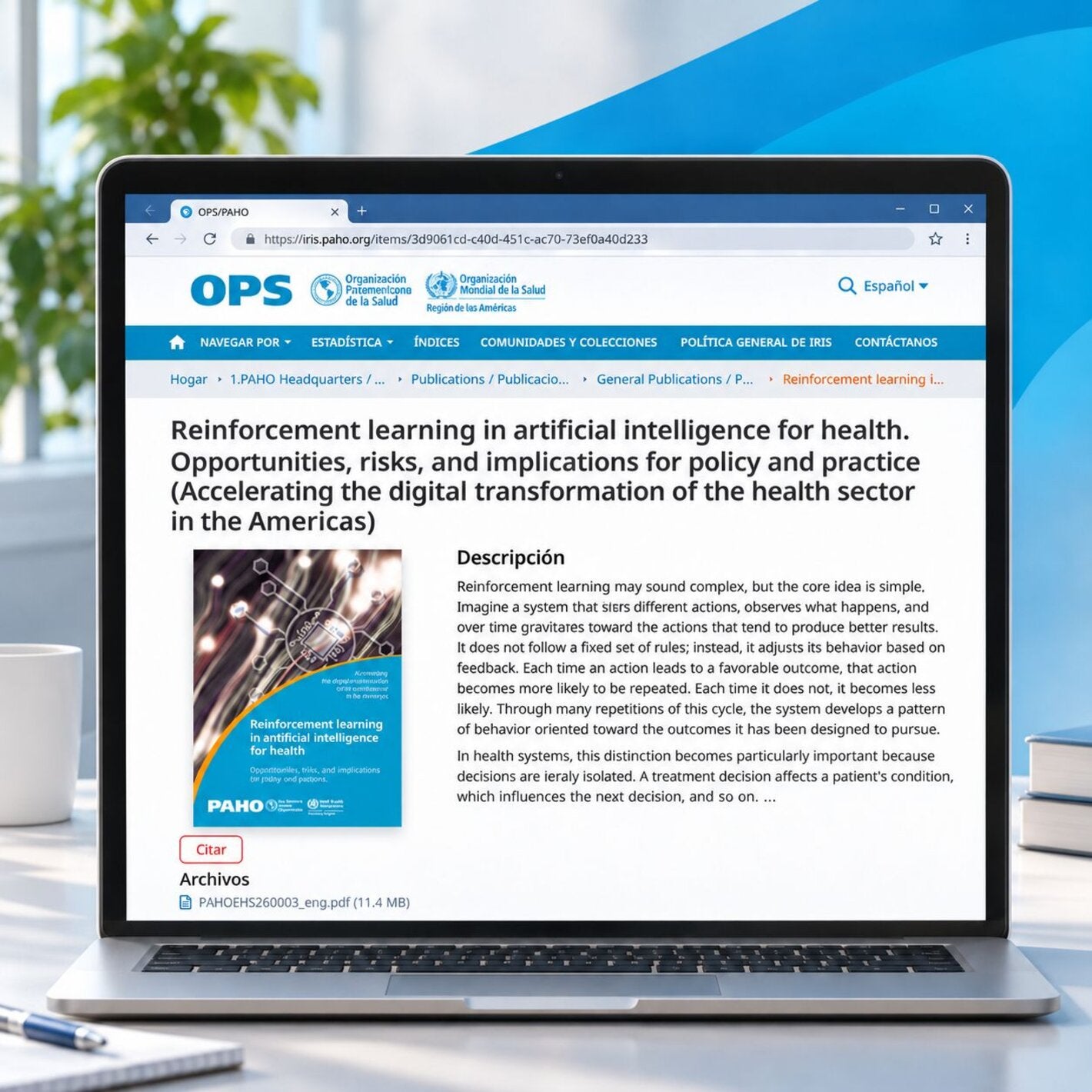
Washington, D.C., 20 November 2026 (PAHO) – The Pan American Health Organization (PAHO) presents a new publication, "Reinforcement Learning in Artificial Intelligence for Health: Opportunities, Risks, and Implications for Policy and Practice," which examines the opportunities, risks, and implications of reinforcement learning in artificial intelligence (AI) for health systems. The document provides guidance for policymakers, health authorities, technical teams, and health professionals to better understand the potential of this technology and promote its responsible implementation.
Reinforcement learning represents a step forward toward AI systems capable of supporting decisions that evolve over time. While traditional models primarily focus on analyzing information and predicting outcomes, this approach enables the identification and adjustment of strategies based on feedback from previous decisions.
In health systems, where clinical and public health decisions are often part of continuous processes, this capability opens up new possibilities. For example, it can help optimize treatment sequences, support the care of people living with chronic conditions, improve the allocation of health resources, and develop public health interventions that adapt to changing epidemiological and operational conditions.
The publication, entitled Reinforcement Learning in Artificial Intelligence for Health: Opportunities, Risks, and Implications for Policy and Practice, highlights that the potential of these technologies depends not only on their technical capabilities but also on the institutional conditions that support their implementation.
One of the main challenges is preventing these systems from reproducing or amplifying inequalities embedded in historical data. Furthermore, due to their adaptive nature, these models require validation, monitoring, and continuous evaluation mechanisms to identify potential risks to safety, equity, and quality of care.
In this regard, the document emphasizes the importance of high-quality data, interoperable digital infrastructure, appropriate governance frameworks, and technical and institutional capacities. It also underscores that human oversight must remain an essential component, ensuring that AI-generated recommendations strengthen, rather than replace, the judgment of health professionals and decision-makers. This approach aims to foster innovation without compromising patient safety, equity, or the protection of fundamental rights.
The publication is part of PAHO's ongoing efforts to advance the digital transformation of the health sector in the Americas and promote the development and use of safe, equitable, and people-centered artificial intelligence technologies.
More information
Full publication (in English):
Mailing list: Subscribe here to receive updates on publications, activities, and resources related to artificial intelligence and digital health.