Canada’s Chief Public Health Officer Joss Reimer said that the principles of the Ottawa Charter continue to guide responses to challenges such as noncommunicable diseases, health inequities, the climate crisis, and misinformation through actions that address the social, economic, and environmental determinants of health.
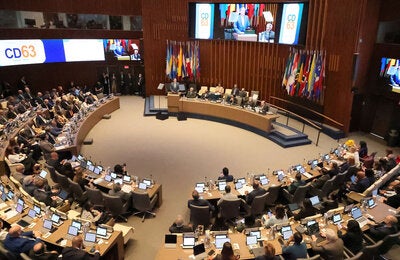
Washington, D.C., 14 September 2026 — In the context of the launch of Wellness Week in the Americas 2026, promoted by the Pan American Health Organization (PAHO), leading international experts agreed that the principles established by the Ottawa Charter remain an essential framework for addressing today’s public health challenges. The event featured the keynote address, 40 Years of the Ottawa Charter: Achievements, Unfinished Agenda, and Future Perspectives, delivered by Joss Reimer, Canada’s Chief Public Health Officer, as well as a panel discussion on current challenges in health promotion. Representatives of local governments, community networks, and WHO Collaborating Centres examined the role of social participation, equity, and climate action in building healthier and more resilient societies.
Reimer emphasized that the Ottawa Charter transformed the way health is understood by recognizing that it “is created in the settings where people are born, grow, learn, work, and age.” Four decades later, “its principles remain as relevant as ever” in guiding responses to challenges such as noncommunicable diseases, population ageing, inequities, and climate change. “Health promotion is more relevant today than ever before,” she said.
Reimer underscored that achieving better health outcomes requires going beyond health care services and addressing the social, economic, environmental, and cultural factors that shape opportunities for well-being. She also warned of new realities affecting public health, “from the climate crisis to misinformation in digital environments. We must ensure that no one is left behind in accessing the conditions necessary for a healthy life,” she stressed. Canada’s Chief Public Health Officer further noted that “wildfires, heatwaves, and other extreme events highlight the close relationship between health and the environment,” arguing for strengthened community resilience and public policies that integrate climate adaptation, equity, and citizen participation. “Climate action is also health action,” she emphasized.
Reimer called for the 40th anniversary of the Ottawa Charter to be used as an opportunity to renew the global commitment to health promotion. She emphasized that building healthier societies requires political leadership, strong partnerships, and a long-term vision that places people and communities at the center of decision-making.
Challenges, participation and local approach
During the panel discussion held as part of the launch event on Current Challenges for Health Promotion, Pablo Anzalone, representative of the Southern Cone Network of Healthy Municipalities and Communities, highlighted social participation as one of the fundamental pillars of health promotion. Anzalone noted that the most sustainable advances occur when communities move beyond being passive recipients of public policies and become active participants in their design and implementation. “There is no health promotion without genuine community participation,” he said.
He argued that strengthening local leadership, community networks, and spaces for dialogue is essential to addressing complex challenges and reducing inequalities. In his view, building well-being requires recognizing the knowledge and experience of communities themselves. “The most effective solutions often emerge from the territories,” he added.
Stephen Fawcett, Director of the WHO Collaborating Centre for Community Health and Development at the University of Kansas, focused his remarks on the role of health promotion in responding to the climate emergency. He explained that the impacts of climate change disproportionately affect the most vulnerable populations and require coordinated responses across multiple sectors.
“The climate crisis is also a health equity crisis,” he said. Fawcett emphasized that health promotion provides tools to strengthen community resilience, foster civic participation, and improve adaptive capacity in the face of growing risks. He presented progress in initiatives aimed at promoting more meaningful community participation in health-related decision-making. “Communities must be partners in the solutions, not merely beneficiaries of them,” he said.
Dina González Alfaro, Mayor of Calle Larga, Chile, and President of the Regional Movement of Healthy Municipalities, Cities and Communities, shared her municipality’s experience in integrating health and well-being into local governance. She explained that citizen participation has been key to designing policies tailored to the needs of the population and to strengthening ties between local authorities and the community.
González Alfaro highlighted initiatives related to healthy urban planning, disease prevention, environmental protection, and strengthening social cohesion. “Local governments play a strategic role in translating the principles of health promotion into concrete actions that improve people’s daily lives. Healthy cities and communities are built on trust and participation,” she concluded.