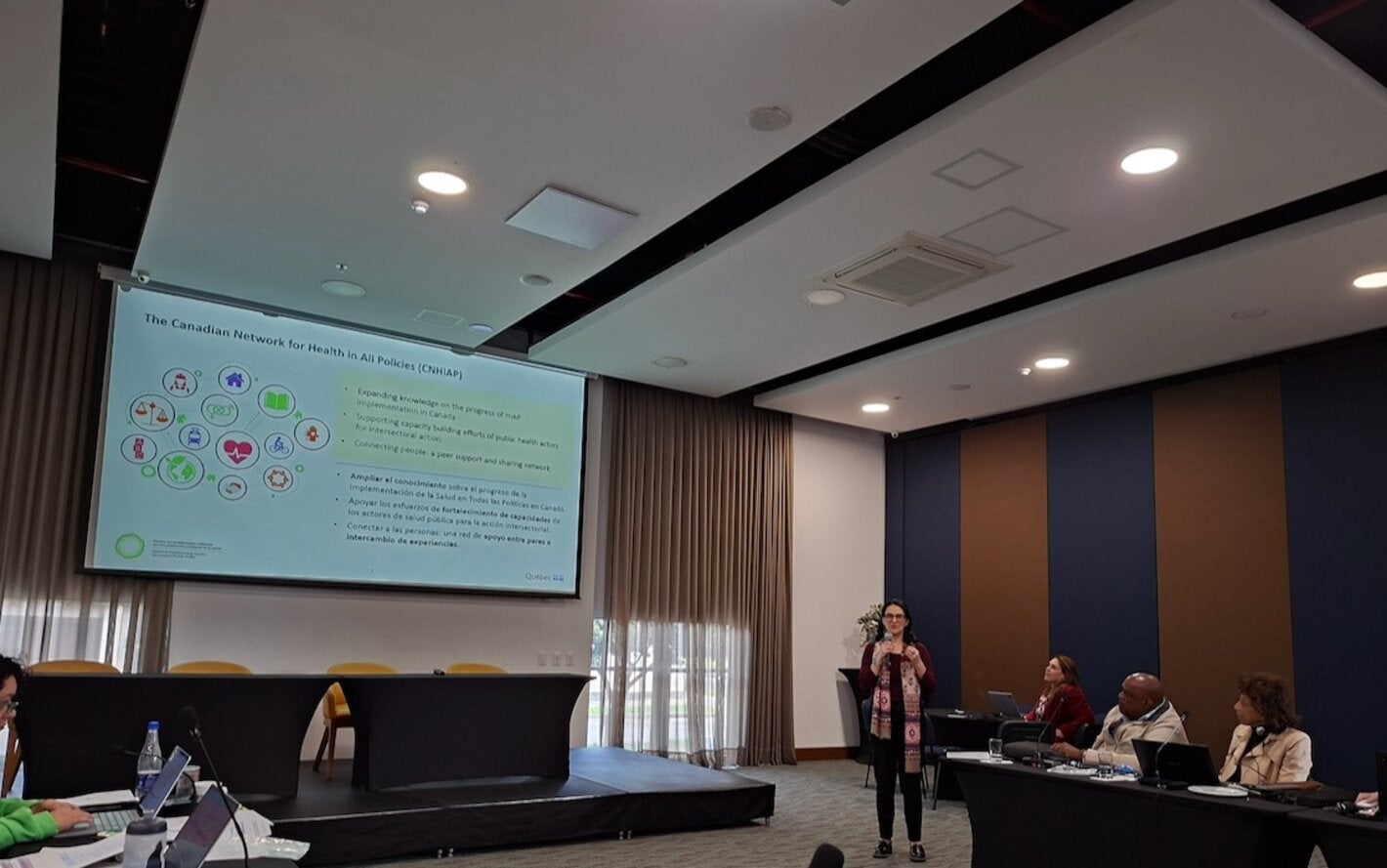
Bogotá, Colombia, 29 May 2026 — From May 26 to 27, Bogotá hosted the Third Meeting of Experts for the Development of a Monitoring and Evaluation Framework for Intersectoral Action for Health Equity, a space led by the Pan American Health Organization (PAHO/WHO) that brought together international experts and representatives from national, subnational, and local governments, as well as academia, to advance the development of tools to strengthen governance for health and well-being in the Region of the Americas.
The meeting is part of an international process launched in Rio de Janeiro in 2024, which has been consolidated through virtual sessions and in-person meetings aimed at developing a conceptual, methodological, and operational framework for the monitoring and evaluation of intersectoral action and Health in All Policies approaches.
During the opening of the meeting, Gina Tambini Gómez, PAHO/WHO Representative in Colombia, stated that “today, more than ever, governments, institutions, and social and community organizations need monitoring systems that make it possible to assess not only isolated sectoral results, but also coordination capacities, multilevel governance, social participation, institutional integration, and the generation of public value.” She also emphasized that health and well-being do not depend exclusively on health systems, but also on multiple social, economic, environmental, and territorial factors that require coordinated responses across sectors and levels of government.
Participants highlighted the importance of strengthening governance capacities for health and well-being, understood as the ability of governments, institutions, and social actors to guide collective decision-making toward improved living conditions, equity, and well-being through political leadership, multilevel coordination, social participation, and intersectoral action.
“What we are discussing here goes beyond the development of a set of indicators. We are participating in the creation of an architecture that strengthens governance processes for health and well-being,” reaffirmed Tambini Gómez. Throughout the working sessions, participants discussed domains and indicators related to the alignment of goals and commitments, governance, an equity approach, social participation, and process evaluation. They also addressed the categories used to define the degrees of intersectorality in public policies and interventions.
During the meeting, experiences and successful cases were also presented, enabling reflection on key considerations for evaluating intersectorality from an equity perspective. These experiences highlighted the importance of understanding not only the outcomes achieved, but also the institutional capacities, coordination processes, and dynamics of social participation that make intersectoral action possible.
Similarly, concrete contributions of intersectorality evaluation to the design, implementation, and strengthening of public policies at different administrative and government levels were highlighted, showing how monitoring and evaluation systems can become strategic tools for guiding decision-making, improving coordination across sectors, and strengthening governance for health and well-being.
In addition, participants reflected on the need for monitoring and evaluation systems not to be limited solely to measuring final outcomes, but also to enable an understanding of how institutional capacities are built, how relationships across sectors are strengthened, and which conditions facilitate or hinder intersectoral action aimed at reducing health inequities.
As a result of the meeting, progress was made in developing a roadmap for the evaluation system of intersectoral action, and national and local initiatives were identified that could contribute to piloting the monitoring instrument.
PAHO/WHO recognizes that this process represents an important step toward strengthening the capacities of countries and territories in monitoring and evaluating intersectoral action, as well as policies and initiatives aimed at addressing the social determinants of health and advancing toward more equitable, healthy, and sustainable societies.