
Organization
This virtual seminar is organized by the Health Promotion and Social Determinants of Health Unit, part of the Department of Social and Environmental Determinants for Health Equity at the Pan American Health Organization / World Health Organization (PAHO/WHO).
Context: SDH and PHC
The Region of the Americas continues to face deep and longstanding health inequities, whose roots lie not in biological differences between individuals, but in the social, economic, and territorial conditions in which people are born, grow, live, work, and age. These conditions, known as the social determinants of health (SDH), influence who accesses services, how they access them, and who is systematically left behind.
Historically, primary health care (PHC) has been conceived as the most inclusive, equitable, and cost-effective strategy for improving population health. The Alma-Ata Declaration (1978) and, more recently, the Astana Declaration (2018) reaffirmed the global commitment to comprehensive PHC that addresses the SDH through intersectoral action and community empowerment. Similarly, the WHO Operational Framework (2021) and the Alliance for Primary Health Care in the Americas (2023), promoted by PAHO, the IDB, and the World Bank, have reinforced the central role of the SDH and equity in transforming health systems in the region.
However, the implementation of PHC across countries in the Americas has been uneven. In practice, in many settings, approaches focused on disease control have prevailed, perpetuating a biomedical perspective and only limited actions to address the social causes that generate and reproduce illness.
Operational Framework
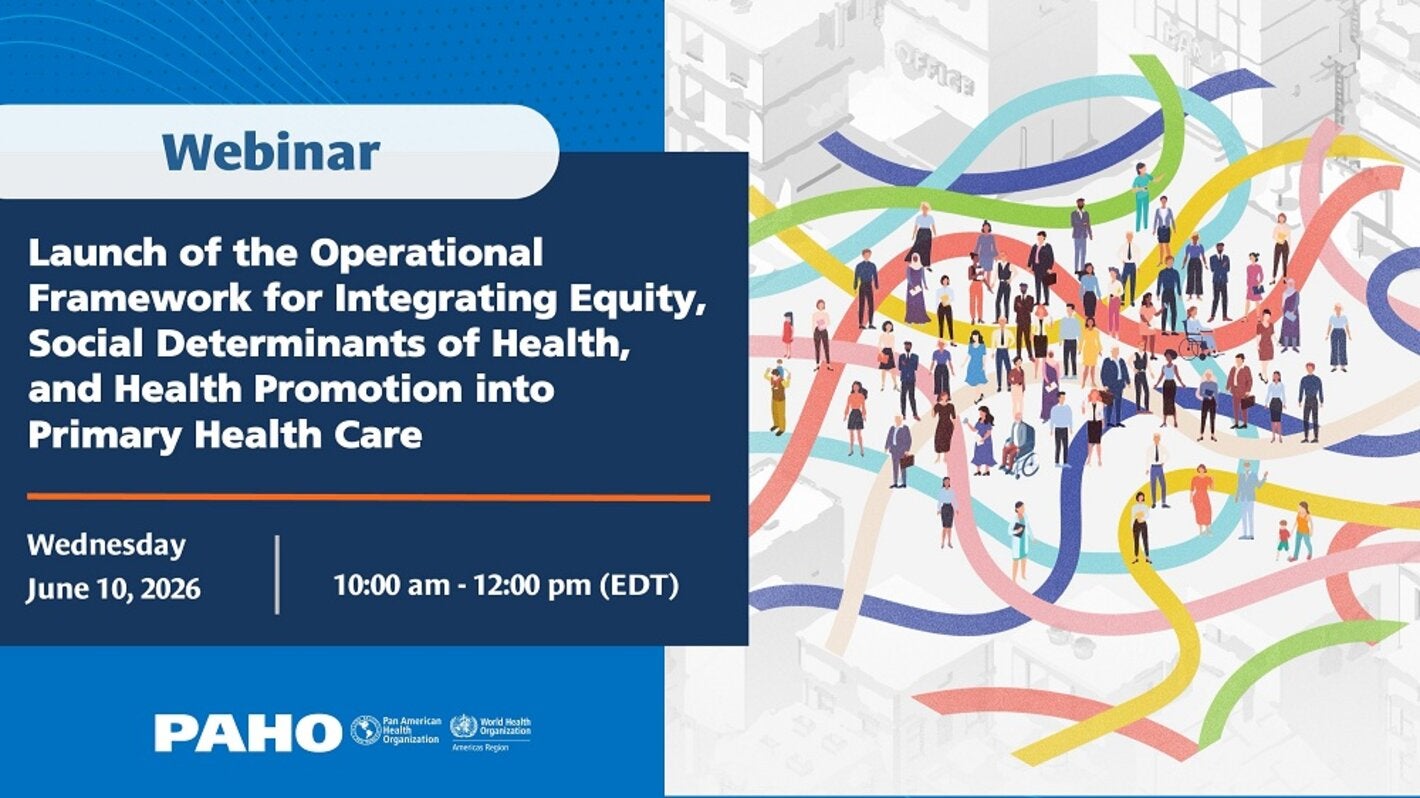
In response to this challenge, the Pan American Health Organization (PAHO/WHO) has developed the Operational Framework for integrating the equity approach, social determinants, and health promotion into primary health care, led by the Health Promotion and Social Determinants of Health Unit (DHE/HP). The Framework proposes practical guidance and concrete tools to incorporate the SDH and equity approach into the daily work of the primary level of care, in an intersectoral and participatory manner, adaptable to the diverse territorial realities of the Region.
The Framework is organized around four interrelated areas: the territory as a social, political, and cultural space where ways of life and inequalities are manifested; key actors (community, health teams, and local governments); drivers of change (intersectoral action and social and community participation); and six operational processes that put the equity approach into practice in PHC: participatory, equity-focused territorial assessments; identification and reduction of access barriers; mobilization of community assets; social prescribing; integration of social and health services; and strengthening local governance for health equity and well-being.
Objetives
To present the conceptual framework and operational components of the PAHO/WHO Operational Framework within the regional PHC and health equity context; to showcase country experiences from across the Region that illustrate the integration of equity and social determinants approaches into primary health care, in alignment with the Framework’s operational processes; and to create a space for technical reflection among experts, international organizations, and health system representatives on the opportunities and challenges for implementing this approach at the regional level.
Participación
- DATE: Wednesday, 10 June 2026
- LANGUAGES: Spanish and English
- TIME: 10:00 AM - 12:00 PM (ET, Washington, Chile, Bolivia)
- OTHER TIME ZONES: Buenos Aires, Brasilia (11:00 AM), Ciudad de México (8:00 AM), Bogotá, Lima, Panamá (9:00 AM).
- PLATFORM: ZOOM (with registration)

Agenda
Topic
Opening remarks
Dr. Jarbas Barbosa. Director, Pan American Health Organization (PAHO)
Institutional remarks: strategic context of the Operational Framework
Gerry Eijkemans. Director, Department of Social and Environmental Determinants for Health Equity, PAHO
Presentation of the Operational Framework for integrating the equity approach, social determinants of health (SDH), and health promotion into primary health care (PHC)
Orielle Solar. Unit Chief, Health Promotion and Social Determinants of Health, PAHO
Experience from Costa Rica: Community Assets and Social Prescribing at the Primary Level of Care
Luis Carlos Vega Martínez. Director, Brunca Integrated Health Service Delivery Network, Costa Rican Social Security Fund
Experience from Chile: Integrating Social Determinants of Health (SDH) into the Comprehensive Chronic Care Strategy (ECICEP) through the integration of social and health services and the inclusion of community assets
Carolina Quintana Hermosilla. Community Technical Reference, Department of Health, Municipality of Alto Hospicio
Sara Díaz Grenett. Community Coordinator, Department of Health, Municipality of Alto Hospicio
Experience From Brazil: Integration of equity, health promotion, and social determinants into the work of primary health care (PHC)
Camila Helen de Almeida Silva Oliveira. Superintendent of Primary Health Care, Minas Gerais State Health Secretariat
Panel Of Commentators: Reflections On The Framework And Country Experiences
Ernesto Báscolo. Unit Chief, Primary Health Care and Integrated Service Delivery Health Systems and Services, PAHO
Cristian Herrera. Senior Specialist, World Bank / Primary Health Care Alliance
Kumanan Rasanathan. Executive Director of the Alliance for Health Policy and Systems Research
Closing Remarks
Health Promotion and Social Determinants of Health Unit