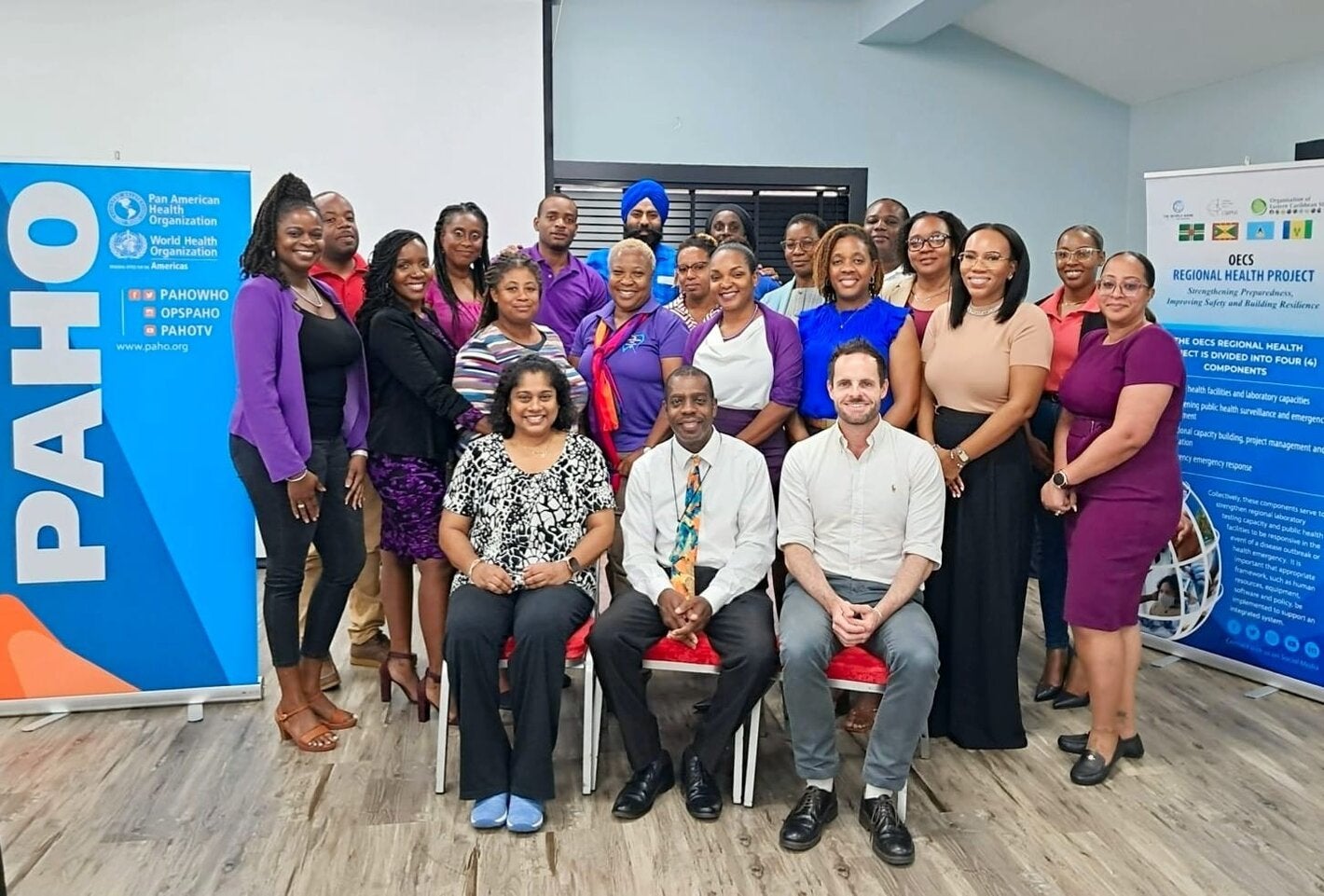
Castries, Saint Lucia,16 May, 2025 (PAHO) – In a strategic move to strengthen national resilience and public health readiness, the Pan American Health Organization (PAHO), in collaboration with the Ministry of Health, Wellness and Elderly Affairs of Saint Lucia, successfully facilitated a five-day National Multi-Hazard and Pandemic Preparedness Plan Review Workshop from 12–16 May 2025. The activity represents a pilot initiative that merges pandemic preparedness with all-hazard emergency planning—offering a scalable model for Small Island Developing States (SIDS) across the Caribbean.
The workshop brought together public health professionals, emergency responders, and key health partners to review and revise Saint Lucia’s Multi-Hazard Health Sector Disaster Management Plan (MHHSDMP) and Pandemic Preparedness Plan (PPP).
Using a harmonized approach grounded in WHO’s PRET framework, PAHO’s Multi-Hazard Response Framework (MRF), and the Strategic Tool for Assessing Risks (STAR), the review sought to bridge gaps exposed by recent crises, including COVID-19.
“In recent years, the Caribbean has faced a series of multi-dimensional threats—from hurricanes, floods, and volcanic eruptions to the unprecedented impact of the COVID-19 pandemic. While Saint Lucia has developed some capacity to manage these challenges, it is evident that we must continue strengthening our preparedness and response.
This workshop marks a key milestone in that effort. It aims to integrate pandemic preparedness into the broader multi-hazard framework, ensuring that our plans are responsive to both traditional and emerging threats."
Ms Jenny Daniel. Permanent Secretary in the Ministry of Health, Wellness and Elderly Affairs.
The review process revealed several key gaps in Saint Lucia’s preparedness planning. These included unclear activation levels for emergencies, particularly in defining the roles and responsibilities of Health Emergency Operations Centres (HEOCs); insufficient coordination mechanisms between health and non-health sectors; outdated standard operating procedures (SOPs) and inconsistent training across stakeholder agencies; and limited contextualization of global preparedness frameworks to the realities of small island settings.
These challenges were addressed through targeted working groups, scenario-based simulations, SOPs development, and the creation of a national training syllabus. Notably, the shared methodology supported the identification of both strategic and operational priorities for immediate implementation.

The PAHO ECC is pleased to continue to support the Ministry of Health Saint Lucia in strengthening its readiness for emergency management in a multi- hazard environment. The update of the plan and development of training syllabus were key success points. Participants engaged in full-day sessions on plan alignment, intersectoral coordination, data and reporting structures, and HEOC integration—culminating in a dual simulation exercise involving both natural hazards and an infectious disease outbreak. Lessons learned were directly translated into plan revisions.
"This timely workshop brought together key stakeholders from across the health sector, national emergency response agencies, and partner institutions to critically assess our current plans, identify gaps, and align our response strategies with regional and international best practices. There was a high level of enthusiasm and engagement demonstrated by participants which led to valuable and productive contributions toward revision of the plan.
Some of the key outcomes of the workshop included a clearer definition of roles and responsibilities across agencies, recognition of a need for strengthened coordination mechanisms for public health emergencies and recommendations for simulation exercises and capacity-building activities through the development of the training syllabus."
Dr. Delphina M. Vernor Senior. Medical Officer, Ministry of Health, Wellness and Elderly Affairs.
The revised preparedness plans will support Saint Lucia’s compliance with the International Health Regulations (IHR 2005) and contribute to the objectives of the Organization for Eastern Caribbean States (OECS) Regional Health Project, funded by the World Bank. The country is also developing a comprehensive implementation roadmap, including partner engagement and resource mobilization for sustained progress.
This pilot effort will serve as a regional model for PAHO’s continued technical cooperation across the Caribbean, particularly in building multi-hazard preparedness strategies that are inclusive, evidence-informed, and future-ready.