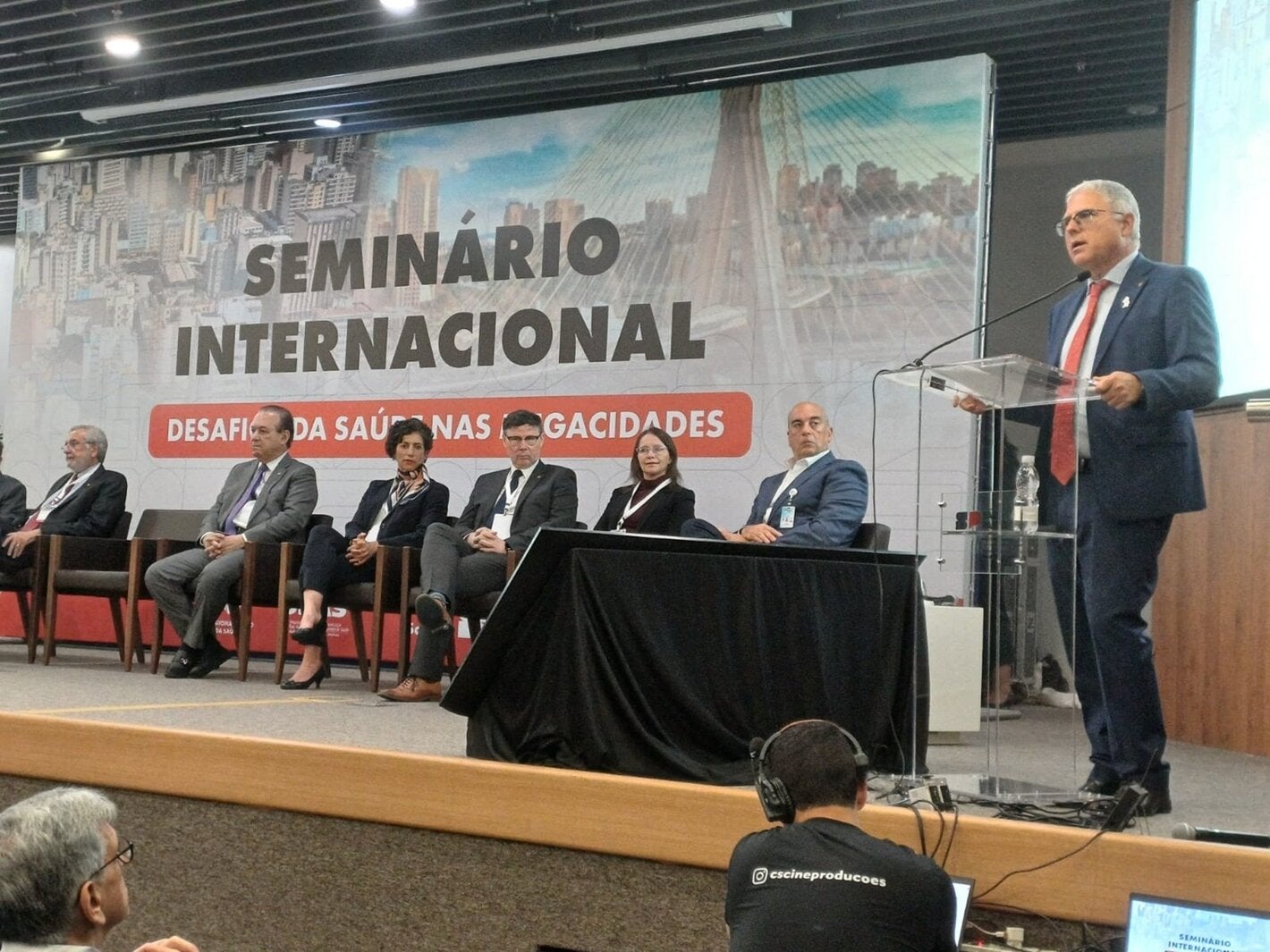
São Paulo, September 23, 2025 – In partnership with the Pan American Health Organization (PAHO), the São Paulo State Health Secretariat (SES-SP) held on Tuesday (23) the International Seminar on the Challenges of Health in Megacities, at the Sírio-Libanês Hospital’s Teaching and Research Institute, in São Paulo.
The meeting brought together experts representing cities from six countries of the Region – Argentina, Brazil, Canada, Chile, Mexico, and Peru– to discuss innovative and sustainable solutions for public health, at a strategic moment, connected to the COP30 agenda, which will take place in November in Belém, Brazil.
In the Region of the Americas, there are eight megacities with more than 10 million inhabitants living in urban areas: São Paulo, Rio de Janeiro, Mexico City, New York, Los Angeles, Buenos Aires, Bogotá, and Lima. With unequal distribution of risk factors within those metropolises, populations face problems such as a higher burden of noncommunicable diseases, especially cardiovascular events, diabetes, and neoplasms. In addition, inequalities persist in access to health services, safe water, and sanitation.
International cooperation for more resilient systems
At the opening session, PAHO and the World Health Organization (WHO) Representative in Brazil, Cristian Morales, highlighted the importance of cooperation between countries, institutions, and communities to address the impacts of urbanization, demographic transition, and climate change. “The union of governments, health workers, researchers, civil society, and international organizations is essential to building more integrated and resilient systems,” said Morales.
The State Secretary of Health of São Paulo, Eleuses Paiva, mentioned that the major cities of the Americas face similar challenges. “Through dialogue, by listening to people and promoting this exchange, we are increasingly accelerating healthcare delivery in our country and across Latin America,” he stated.
Eleuses Paiva and Cristian Morales also emphasized the joint work of PAHO with SES-SP to strengthen health regionalization in the state, which has helped reduce inequalities between metropolitan and inland territories, placing people at the center of the health system and the care provided by services.
Urban health as a global agenda
The keynote lecture was delivered by James Fitzgerald, Director of PAHO/WHO’s Department of Health Systems and Services. In his address, Fitzgerald emphasized that the health of megacities will be decisive for global health, since by 2050 more than two-thirds of the world’s population will live in urban areas.
He reminded participants that megacities concentrate deep social and health inequities, reflected in significant differences in life expectancy across neighborhoods and populations. “These inequities are avoidable and unjust, and require integrated public policies, with primary health care as the cornerstone of universal health systems,” he stated.
According to Fitzgerald, these barriers affect women, low-income groups, rural populations, and people with less education the most, reflecting inequalities between and within countries. As a strategy to overcome these challenges, PAHO works to strengthen the resilience of health systems, emphasizing the care provided by Primary Health Care.

The event’s program included a preparatory technical meeting and thematic panels for the exchange of national and international experiences, including the city of São Paulo and UN-Habitat, as well as discussions on innovative public policies in megacities such as Lima and Buenos Aires, among others.
The representatives of the megacities in attendance agreed to establish a working group to advance shared priorities. These include strengthening health service networks, improving the governance of health systems in megacities, addressing health inequities, promoting health and well-being among urban populations, and fostering urban planning that supports a better quality of life for all. The next meeting on health in megacities is scheduled to take place in March 2026, in Mexico City, Mexico.
Given its historical cooperation with the State and Municipal Health Secretariats of São Paulo – where the Center is based – BIREME also followed the event and discussions, reinforcing its commitment to strengthening technical cooperation through access to scientific and technical information.