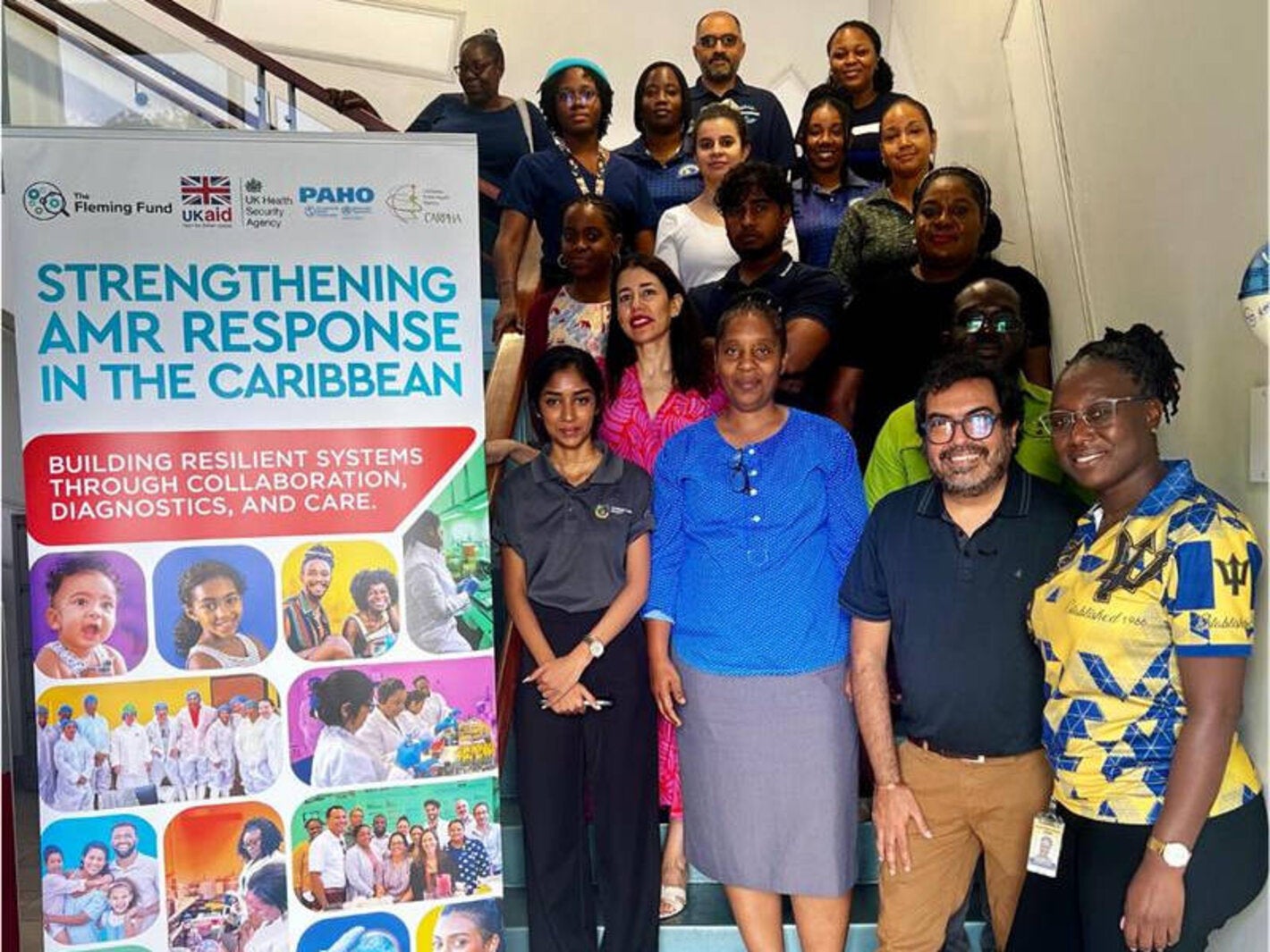
Bridgetown, Barbados, November 2025 (PAHO/WHO) - As the world marked World Antimicrobial Resistance Awareness Week (WAAW) last week, laboratory technologists from across the Caribbean came together in Barbados for an intensive hands-on workshop to strengthen the region’s capacity to detect and respond to antimicrobial resistance (AMR).
Held from 18 to 21 November 2025 at the Best-dos Santos Public Health Laboratory in Bridgetown, the four-day Whole Genome Sequencing (WGS) training workshop formed part of ongoing efforts to equip national laboratories with the tools and knowledge needed to protect public health. The Best-dos Santos Laboratory has long been a key PAHO/WHO partner, acting as the subregional reference laboratory for AMR External Quality Assurance for Eastern Caribbean Countries (ECC), supporting these nations in the identification and characterization of emerging antimicrobial resistance, including during urgent outbreak investigations, and working closely with PAHO to build and expand molecular techniques capacity.
The training was coordinated by the PAHO/WHO Special Program on Antimicrobial Resistance under the Fleming Fund-supported project “Strengthening the AMR Response in the Caribbean” and combined theory with practical experience.
The first two days focused on “wet lab” training, where participants learned how to extract, prepare, and sequence bacterial DNA. The final two days introduced bioinformatics analysis, showing participants how to interpret sequencing data t
Participants included public health laboratory technologists from Jamaica, Guyana, and Barbados, with additional representation from The Bahamas and the Caribbean Public health Agency (CARPHA). Sessions were led by international experts from the PAHO/WHO Collaborating Center on AMR Surveillance at INEI ANLIS Carlos G. Malbrán (Argentina) and PAHO headquarters.
Participants gained the skills to apply WGS in their own laboratories - a major step in helping Caribbean countries better track antimicrobial resistance and respond to novel and emerging threats. The overall goal was to strengthen regional capacity for AMR surveillance and containment, while fostering collaboration across Caribbean microbiology networks.
“This workshop marks an important milestone for the Caribbean,” said Advisor, Antimicrobial Resistance Response at PAHO/WHO, Dr Nathalie El Omeiri. “By bringing together national reference laboratories with genomic sequencing capacity, we are strengthening the region’s ability to detect, monitor, and respond to antimicrobial resistance with greater precision and speed. PAHO is proud to support this growing network of excellence, which is essential for safeguarding health security and advancing a more resilient, data-driven AMR response across the Caribbean,” she added.
Medical Technologist from Jamaica, Christine Ehikhamenor, considered the workshop very beneficial. “I really valued the opportunity to collaborate with other technical experts. The workshop sharpened my skills and deepened my understanding, and it was encouraging to have colleagues to exchange questions and ideas with,” she said.
Meanwhile, Danielle Gordon-John, Senior Laboratory Technologist at CARPHA (Trinidad and Tobago), noted, “the workshop clearly demonstrated how each component applies to AMR surveillance in the Caribbean and offered a real snapshot of what is happening in the region. I appreciated connecting with like-minded colleagues and gaining deeper expertise on AMR.”
This year’s World Antimicrobial Resistance Awareness Week (18–24 November) was held under the theme “Act Now: Protect Our Present, Secure Our Future.” The campaign calls on governments, health workers, veterinarians, farmers, environmental professionals, and communities to work together to preserve the effectiveness of life-saving medicines.
The training closed with renewed commitment among participants to apply what they learned, share expertise with peers, and strengthen their countries’ ability to detect and respond to AMR. As the Caribbean continues to build resilience against this global health threat, initiatives like this highlight how partnership, innovation, and shared purpose can secure a healthier future for generations to come.