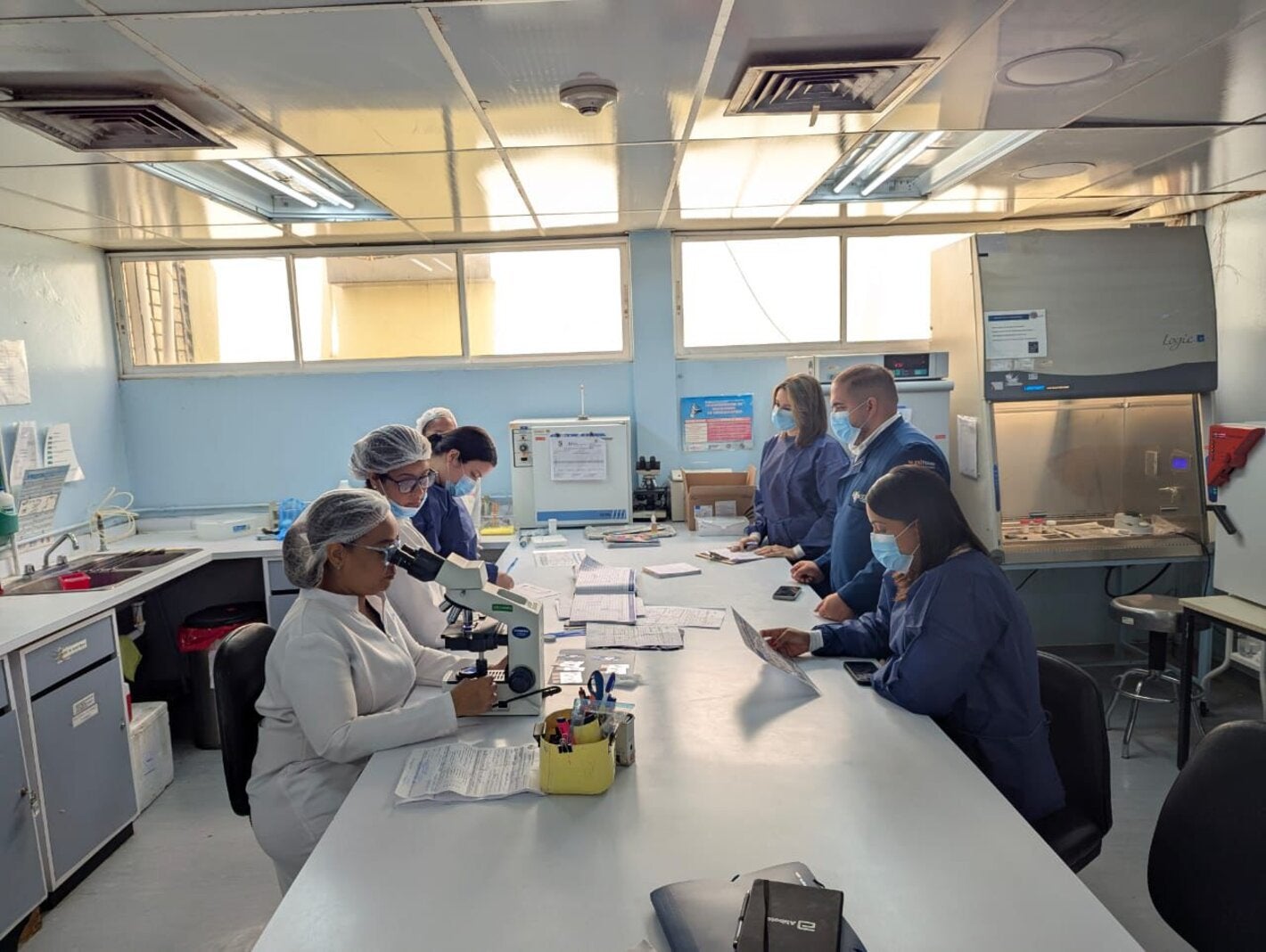
PAHO/WHO and the Ministry of Health are conducting operational research at five health facilities to evaluate the integration of rapid diagnostic tests into health services.
Santo Domingo, Dominican Republic, 7 October 2026 (PAHO) – The Pan American Health Organization/World Health Organization (PAHO/WHO), in coordination with the Ministry of Health and with support from Unitaid, is conducting operational research to strengthen the timely detection of tuberculosis, cryptococcosis, and histoplasmosis among people with advanced HIV disease (AHD).
The study evaluates the use of rapid point-of-care diagnostic tests to bring diagnostic services closer to people and support timely clinical decision-making. These tools are particularly important for individuals who seek care with severely weakened immune systems, a condition in which opportunistic infections can progress rapidly and increase the risk of complications and death.
The study is being implemented at five health facilities: Centro Sanitario Santo Domingo, Hospital Salvador B. Gautier, Hospital Juan Pablo Pina, Hospital Regional Universitario José María Cabral y Báez, and Hospital Infantil Robert Reid Cabral. As of October 2026, a total of 258 participants had been enrolled.
Earlier detection for timely action
Available findings show that a significant proportion of participants had CD4 cell counts below 200 cells/mm³, indicating a high degree of immunosuppression in this population and underscoring the importance of diagnostic tools that enable the timely detection of opportunistic infections and facilitate access to care and treatment.
For tuberculosis detection, 231 participants were screened using the rapid TB-LAM test, of whom 38 tested positive (16.5%). These results enable linkage to the National Tuberculosis Program for further evaluation, diagnostic confirmation, and initiation of appropriate treatment.
The use of rapid diagnostic tests also enabled the identification of cases of cryptococcosis and histoplasmosis, strengthening the capacity of participating health facilities to detect opportunistic infections that may otherwise go undiagnosed when appropriate diagnostic tools are unavailable.
By providing testing at the point of care, these tools facilitate clinical decision-making and help reduce delays between suspected infection and appropriate clinical management.
Generating evidence to strengthen the national response
Beyond evaluating diagnostic tools, the operational research provides insights into how these technologies can be integrated into routine health services, identifies gaps in care pathways, and generates evidence to inform their adoption and potential scale-up across the country.
Unitaid's support is essential to advancing this effort, strengthening national capacities, and evaluating the use of these technologies in real-world healthcare settings. Its contribution helps connect diagnostic innovation with evidence generation to improve the response to advanced HIV disease.
Through this collaboration, PAHO/WHO continues to support the Ministry of Public Health in strengthening timely and comprehensive care for people living with HIV. This experience aims to contribute to preventing avoidable complications and deaths by bringing diagnostic services and care closer to those who need them most.