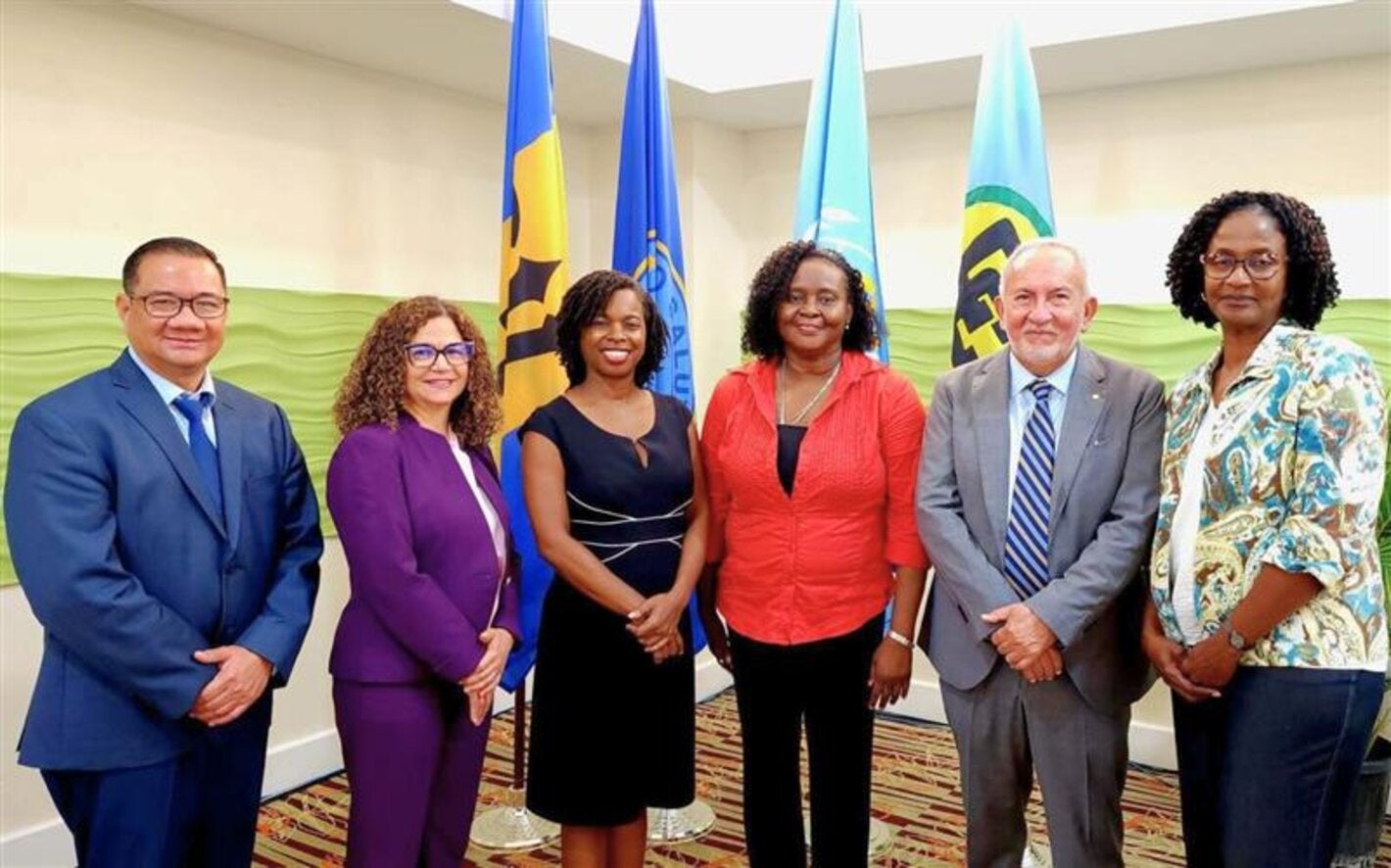
Bridgetown, Barbados, 8 September 2025 (PAHO/WHO) - It was a moment of pride and promise as two Barbadian health professionals, Dr. Joy Anne O’Neale and Ms. Stacia Whittaker, presented their health policy briefs to mentors and personnel of the Pan American Health Organization/World Health Organization (PAHO/WHO) and the Programme Coordinator, The University of the West Indies (UWI), Cave Hill Campus. These presentations marked a step toward the culmination of their practicum experience under the PAHO-UWI Postgraduate Diploma in Health Policy and Health Systems Program, a unique collaboration between PAHO and the UWI that merges academic rigour with practical exposure in the field of public health policy and health systems.
The programme, which began in September 2022, was created to cultivate a new cadre of professionals equipped to shape, evaluate, and implement health policy and strengthen health systems in the Caribbean. PAHO played a key role, not only in the development of the curriculum, but also in hosting a one-week in-person immersion out of the five-week, blended practicum that offered students an inside look at health systems governance at a multilateral level. Guided by Dr. Edwin Vicente Bolastig, Advisor for Health Systems and Services, and Dr. Gloria Giraldo, Advisor for Noncommunicable Diseases and Mental Health – both from the PAHO/WHO Office for the Subregional Program Coordination, Caribbean - as well as Dr. Heather Harewood, Co-coordinator of the Practicum and Lecturer in Public Health & Epidemiology at the Faculty of Medical Sciences, UWI, Cave Hill Campus, the practicum helped transform the often-abstract world of policy into a vivid, lived experience.
Reflecting on the programme’s value, Dr. Bolastig shared: “Serving as both Practicum Co-Coordinator and mentor provides me a singular opportunity to not only help mould future Caribbean health leaders in thinking about evidence-informed policy solutions that help build responsive and resilient health systems but also pursue my passion for ‘praxis’ - converting ideas into action. The development of health policy briefs is where theory meets practice. These briefs become problem-solving tools that focus on pressing health needs PAHO is working to address with Member States.”
Dr. Joy Anne O’Neale, a General Practitioner and Clinical Medical Officer with the Ministry of Health and Wellness in Barbados, focused her policy brief on childhood obesity and policy options for regulating school vendors to reduce the consumption of unhealthy foods in and around schools. Her topic, rooted in the growing burden of NCDs in the region, reflects the importance of upstream policy action in shaping healthier environments. For her, the practicum was transformative. “Chicken Soup for the soul - that’s the name I give the programme,” she said with a smile. “It was tedious for me at first because I don’t think in policy. It took a while for me to get it, but I got it. I have to thank Gloria and Edwin for pulling the strands together. Gloria helped my train from not going off track - I kept heading for the side rails and she kept nudging it back - without telling me what to do, she managed to keep the train on track. And thanks to Heather for helping run this programme.”
Dr. Giraldo also reflected on the mutual value of the exchange: “This program is a wonderful bidirectional opportunity. As PAHO advisors, we are deeply involved in the design, implementation, and enforcement of NCD-related policy. Interacting so closely with practitioners from the fields of medicine and nutrition allows for a rich exchange of experiences, perspectives, and lenses that is immensely enriching for all involved.”
Ms. Stacia Whittaker, a registered dietitian at the St. Michael District Hospital, centred her policy brief on optimising the utilisation and allocation of registered dietitians within the health system - another critical issue in the regional response to NCDs. With a decade of experience in clinical nutrition and food services, she saw the practicum as a pathway to making deeper system-level impact. It’s a really great programme, and I found out about it at the last minute,” she said. “I thought, ‘Here’s something that could help improve the health system.’ We just want to be a different part of the stream. Our love for what we do, our love for our country and healthcare - it’s that we just want to be able to do more.”
She continued, “This programme shows you how you can do more - how you can pull things together. And from Day 1, our time at PAHO was the icing on the cake. Seeing it all firsthand - every interview we had was inspiring. You think one was great, then the next one just blows you away. It showed the like-mindedness of the people at PAHO. And we felt like part of the family. Edwin shared his own personal stories. Gloria was so helpful. Heather has been gracious and patient. Even as the programme ends, I look forward to networking and learning more. I’m a vessel who just wants to grow.”
Reflecting on the broader impact of the practicum, Dr. Heather Harewood, Co-coordinator of the programme, noted: The practicum is the culmination of the two years of classroom-based exercises, discussions and assessments. As facilitators, we also learn from the scholars as they share their unique experiences and desires to contribute to improving the health system. It is a joy to see their growing self- confidence in public speaking, and in applying the research and critical thinking skills required to produce a major programme deliverable – an evidence-informed policy brief on a priority health area of their choosing.
As the programme continues to grow, its impact is already visible in the transformed perspectives and renewed sense of purpose among its graduates. For PAHO, this collaboration is more than a training opportunity, it’s an investment in the future of health systems in the Caribbean. By nurturing professionals like Dr. O’Neale and Ms. Whittaker, the programme is building a generation of policy-literate, systems-focused health leaders equipped to tackle noncommunicable diseases and improve population health. Indeed, as one participant aptly put it, this practicum was not just academic - it was “chicken soup for the soul.”