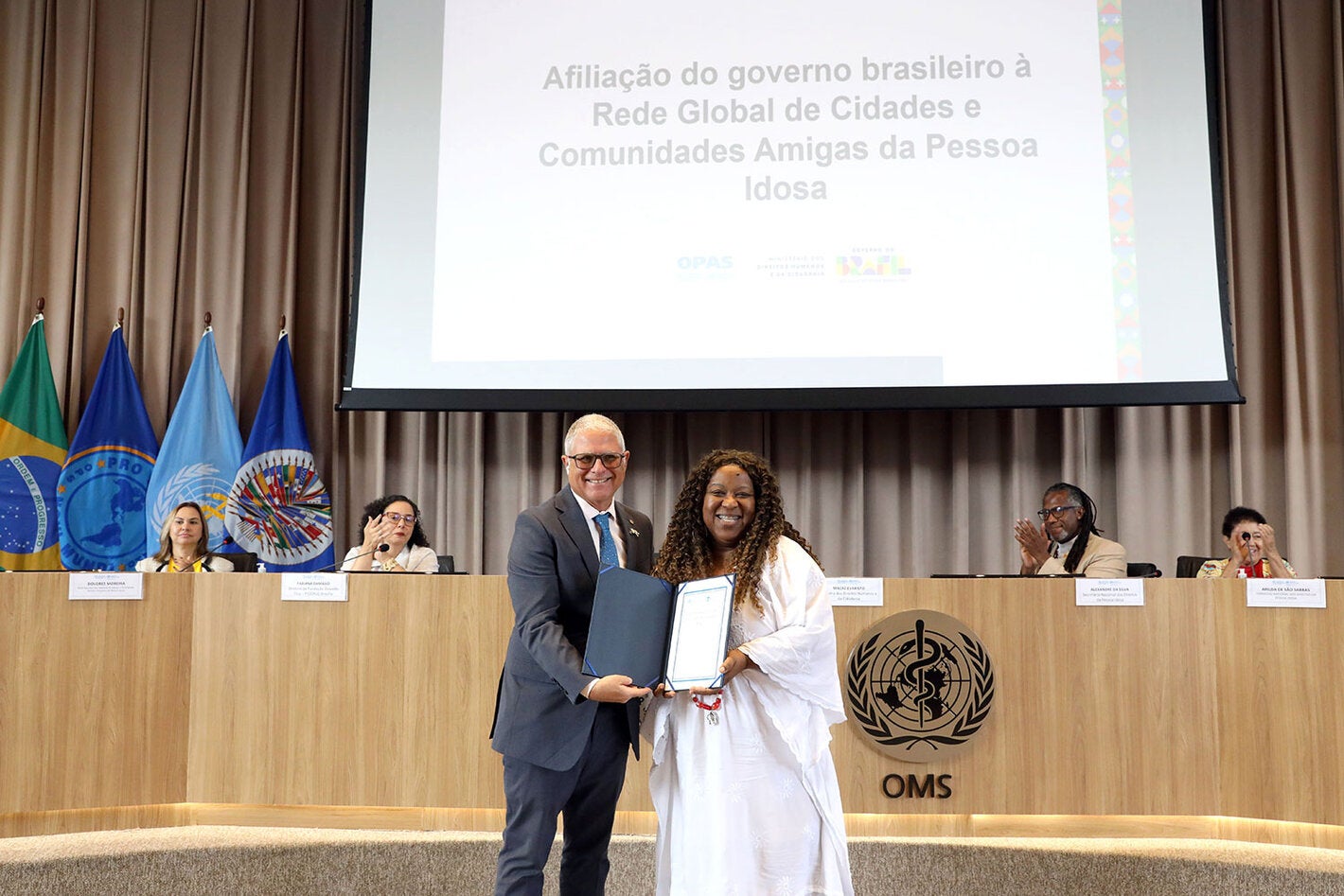
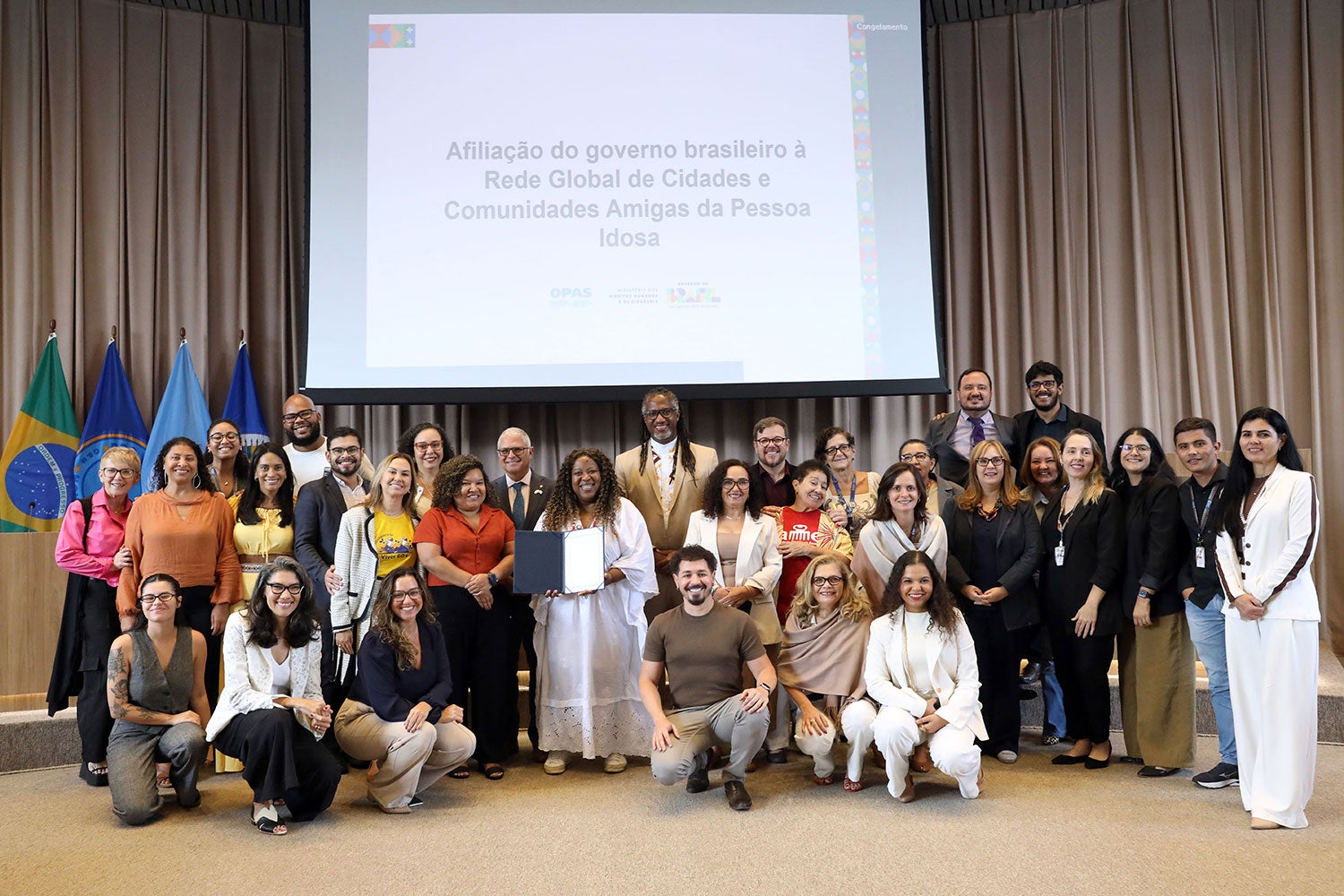
Brasília, March 20, 2026 – With the support of the Pan American Health Organization (PAHO), Brazil has become the newest affiliate of the World Health Organization (WHO) Global Network of Age-Friendly Cities and Communities. This Friday (March 20), the Minister of Human Rights and Citizenship, Macaé Evaristo, received the certificate of membership in the initiative from Cristian Morales, PAHO/WHO Representative in the country. Through this step, Brazil reaffirms its commitment to ensuring that older persons have physical and social environments adapted to enable dignified and healthy aging.
Thiago Hérick de Sá, responsible for the Age-Friendly Environments area in the WHO Department of Social Determinants of Health, stated that Brazil’s accession to the Global Network is a historic milestone. “This commitment raises the agenda to a new level, reinforcing many of the actions already developed to build environments in which everyone can live longer and better.” According to Hérick de Sá, by joining the initiative, the country assumes a position of global leadership. “Brazil has a unique potential to inspire the world. It has a population that is aging rapidly, which means people are living longer in the country - something truly worth celebrating - and ensuring that this trend continues,” he added.
The Minister of Human Rights and Citizenship, Macaé Evaristo, emphasized that Brazil’s participation in the Global Network concretely expresses the country’s commitment to the dignity, participation, and autonomy of older persons. “To effectively guarantee dignity for all older persons, we must act in an articulated, integrated, intersectoral, and interdisciplinary manner, but above all through transnational collaboration, because we know that the policies we develop have a direct impact on reducing inequalities. And if there is one factor today that strains the quality of life of older persons, it is inequality.”
Brazil already has nearly 36 million older persons, recalled Alexandre da Silva, National Secretary for the Rights of Older Persons at the Ministry of Human Rights and Citizenship and President of the National Council for the Rights of Older Persons. “This is the fastest-growing age group in our country, and this is largely due to public policies, particularly the Unified Health System (SUS) and the Unified Social Assistance System (SUAS). In this way, Brazil continues its path of innovation, introducing more actions and also serving as an example for other countries on how to implement effective policies for millions of older persons.”
According to Cristian Morales, the country has been facing new challenges related to the reversal of the population pyramid. “We know the world is aging rapidly, and in Brazil, as in all countries of the Americas, this process is extremely accelerated. By 2039, we will have more people aged over 60 than children and adolescents under 15,” he noted. Therefore, the country’s affiliation with the Global Network, with a renewed commitment to building a better, healthier, and more sustainable world for older persons, represents an important political decision. He added that addressing this issue requires a new perspective on public policies across multiple sectors, such as human rights, health, social assistance, education, security, pensions, sports, and culture.
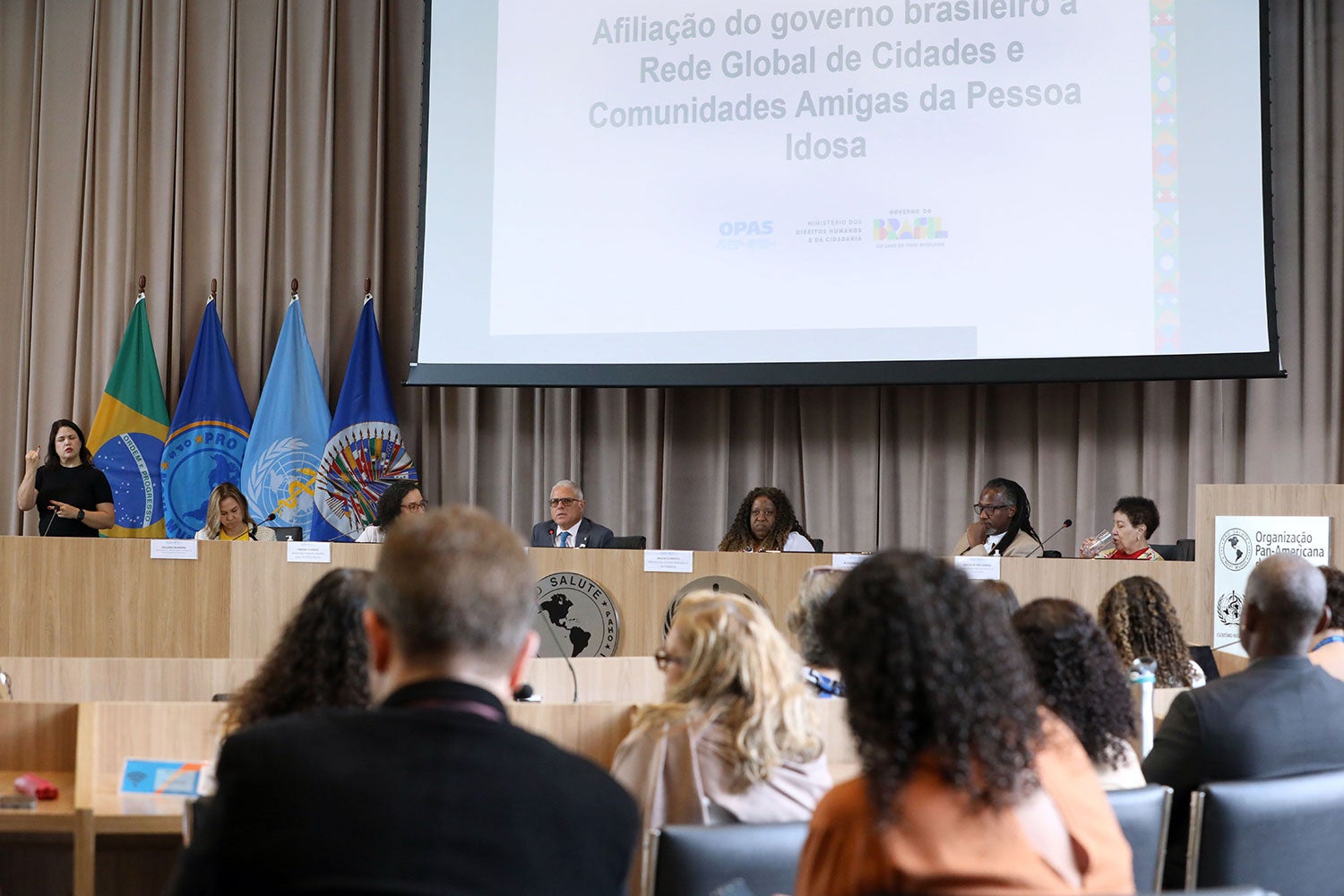
Also participating in the panel were Fabiana Damásio, Director of the Oswaldo Cruz Foundation (Fiocruz) Brasília; Dolores Moreira, from the National Network of State and Federal District Managers for the Rights of Older Persons; and Arilda de São Sabbas, from the National Council for the Rights of Older Persons.
More information about the Global Network of Age-Friendly Cities and Communities
Affiliate members of the Global Network inspire transformation, connect cities and communities, and support participants in identifying and implementing solutions tailored to local realities. The initiative aims to encourage the creation of environments that promote participation, safety, and well-being for older persons, as well as to foster the exchange of experiences and mutual support among cities and communities.
“The Region of the Americas is the leader in the Global Network, with more than one thousand cities and communities in 18 countries, representing more than half of the Network’s members. This leadership demonstrates the growing commitment of countries in our region to the objectives of the Decade of Healthy Aging,” emphasized James Fitzgerald, Director of the Department of Health Systems and Services at PAHO. According to him, Brazil’s affiliation reflects the country’s commitment to healthy aging and to building more inclusive environments for all people throughout the life course.
Currently, Brazil has 69 cities that are part of the Global Network. In addition to Rio de Janeiro, the state of Paraná is also part of the Global Network as an affiliate member. In total, the Network brings together 1,739 member cities and communities in 57 countries and territories. In the Americas, more than 1,009 cities in 18 countries and territories have already joined or are in the process of joining.