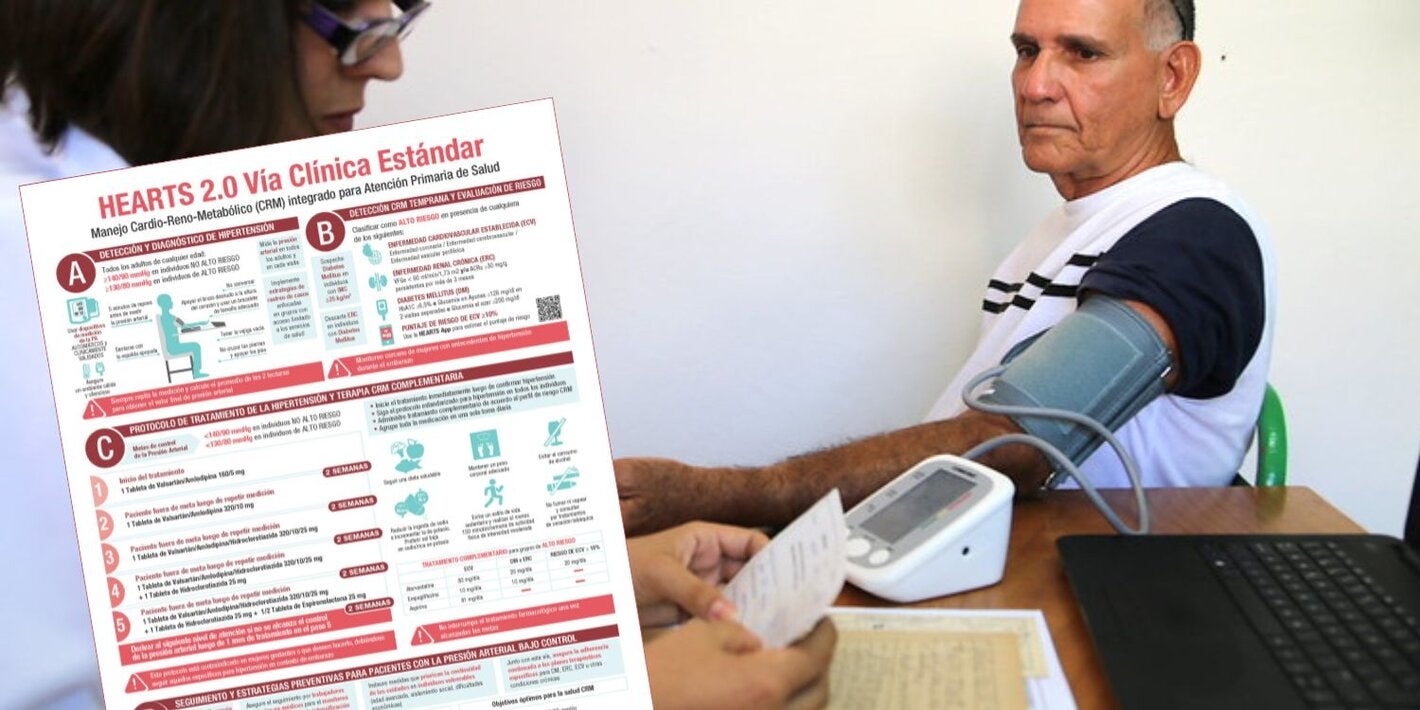
Washington, DC, 15 May 2026 – The Pan American Health Organization (PAHO) has made the new HEARTS 2.0 clinical pathway available to countries in the Region. This update to the previous version maintains hypertension control as the entry point to preventive care but expands the recommendations to strengthen integration with other cardio-renal-metabolic conditions.
The clinical pathway is a key instrument for implementing HEARTS in the Americas, as it provides a standardized, evidence-based model for the clinical management of hypertension and cardiovascular risk in primary health care. Within a single model, it integrates the key components for cardiovascular management, from diagnosis and risk assessment to treatment and follow-up.
A living instrument, adaptable to each country’s context
The first version of the clinical pathway has already been adopted as the national standard for hypertension management in 29 countries of the Region of the Americas, with adaptations to specific national contexts, while maintaining its core principles. HEARTS 2.0 is an enhanced model that will serve as the foundation for future updates to national clinical pathways across countries implementing HEARTS, helping optimize population health outcomes.
HEARTS 2.0 is part of PAHO’s efforts to strengthen primary health care for the prevention and control of noncommunicable diseases (NCDs), under the strategic guidance of the Better Care for NCDs initiative. This initiative promotes primary care focused on prevention and control, and aims to deliver comprehensive, timely care for NCDs, ensuring accessible, coordinated, and people- and community-centered health services.
A synthesis of the best clinical practice evidence
The clinical pathway is also a living instrument capable of evolving to incorporate new evidence, expand its scope, and strengthen health teams' capacity to deliver higher-quality care.
HEARTS 2.0 incorporates the best available evidence from leading global clinical practice guidelines and translates it into a practical tool designed to improve the quality of care in primary health care. Its development followed a three-phase process.
In the first phase, an expert panel identified and selected a set of 45 interventions to be integrated into the existing clinical pathway, covering not only hypertension and cardiovascular diseases, but also diabetes mellitus and chronic kidney disease. The results of this first phase were published in Global Heart. Subsequently, the second phase consisted of assessing countries’ readiness to implement the proposed interventions, with results published earlier this year in the British Medical Journal. The third phase involved a rigorous assessment of the evidence supporting each new intervention and the application of a standardized consensus methodology based on GRADE, enabling the development of the new HEARTS 2.0 clinical pathway. This final phase was documented through publications in the American Journal of Hypertension, The Lancet Primary Care, and PAHO.
This new version of the clinical pathway marks the evolution of HEARTS in the Americas towards an integrated approach to hypertension and cardio-renal-metabolic prevention.
Elements of the HEARTS 2.0 clinical pathway
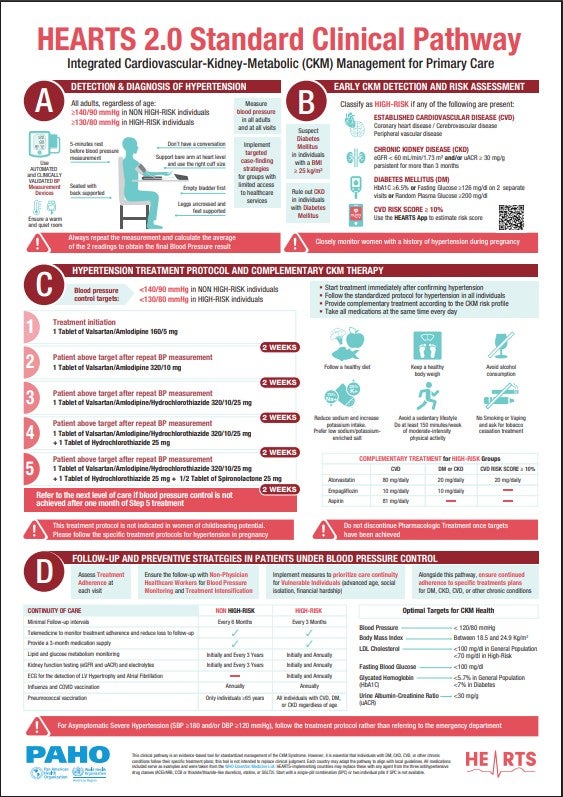
The HEARTS 2.0 clinical pathway includes:
- Accurate diagnosis of hypertension, with standardized criteria.
- Early cardio-renal-metabolic screening and risk assessment using validated tools.
- Simple, standardized pharmacological and non-pharmacological treatment protocols for hypertension and cardio-renal-metabolic prevention.
- Recommended lists of essential medicines for hypertension control.
- Guidance for follow-up, continuity of treatment, screening for complications, and preventive strategies for patients with controlled blood pressure.
Download the HEARTS 2.0 clinical pathway
Related articles
- HEARTS 2.0: an implementation-oriented clinical pathway for integrated care of hypertension and cardiovascular–kidney–metabolic conditions in primary health care in the Americas
- Candidate Interventions for Integrating Hypertension and Cardiovascular-Kidney-Metabolic Care in Primary Health Settings: HEARTS 2.0 Phase 1
- Readiness to deliver integrated cardiovascular, kidney and metabolic care in primary healthcare: phase II of HEARTS 2.0 in 26 countries in the Americas
- Evidence-informed prioritization of interventions for integrating hypertension management into cardiovascular-kidney-metabolic care in primary health care: HEARTS 2.0 Phase 3