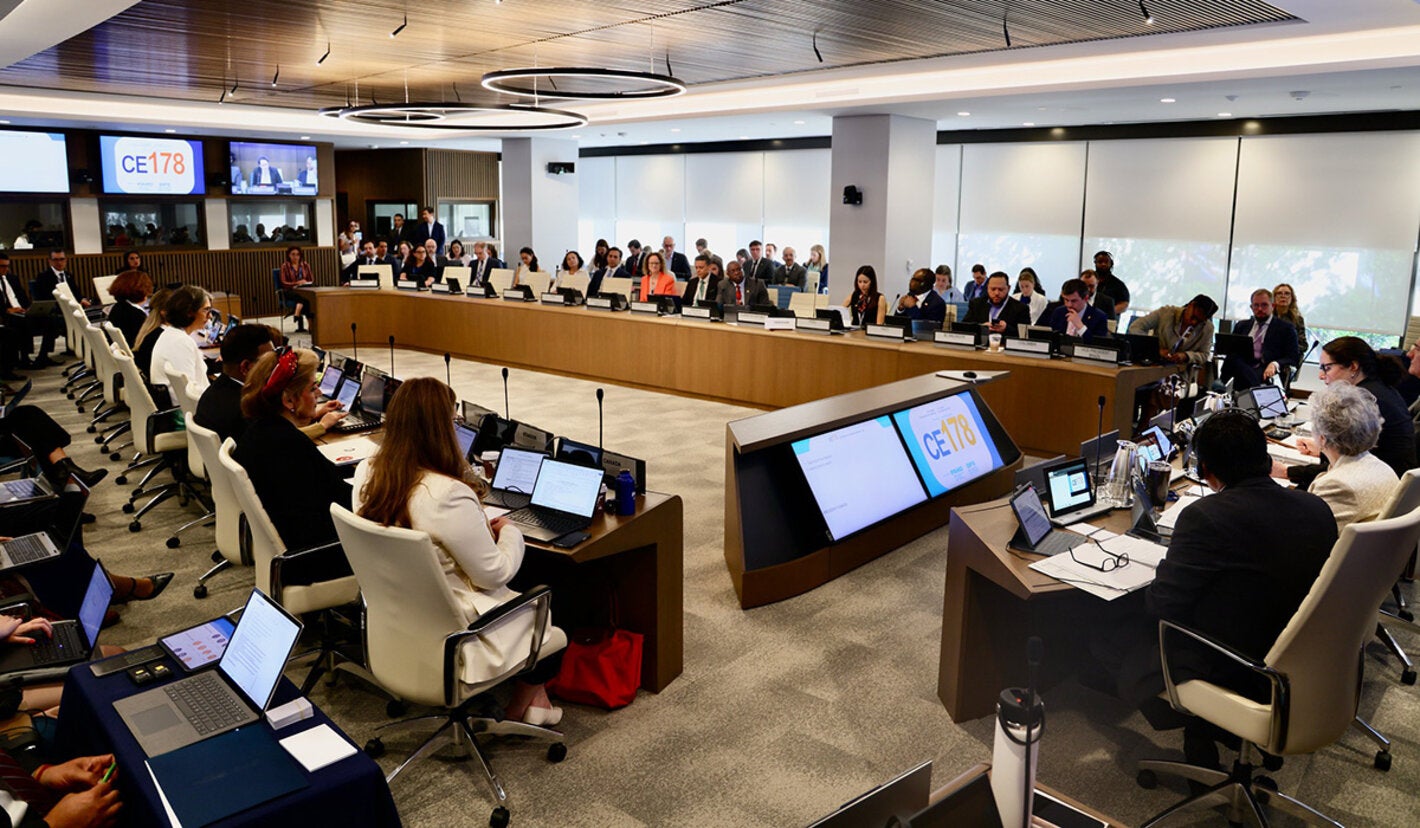
Washington, D.C., 15 June 2026 (PAHO) — The Executive Committee of the Pan American Health Organization (PAHO) today opened its 178th session, where Member States will address the Region’s main health priorities in a context marked by financing challenges and the need to strengthen preparedness for health emergencies.
Over four days, delegates will discuss measures to strengthen preparedness for health emergencies, combat antimicrobial resistance and arboviral diseases, improve food safety, and enhance access to essential health technologies. They will also review the Organization’s financial situation and progress under its strategic and budgetary plans.
“This meeting of the Executive Committee provides a valuable platform to shape the Organization’s approach to addressing these challenges and, ultimately, improving health outcomes across the Region,” PAHO Director Dr. Jarbas Barbosa said in his opening remarks.
Dr. Barbosa highlighted PAHO’s ongoing support to countries to strengthen primary health care, advance digital transformation, prevent and control outbreaks of diseases such as yellow fever, measles and dengue, and reduce preventable deaths from noncommunicable diseases. He also stressed the need to improve maternal, neonatal and child health and address the growing burden of mental health conditions.
He underscored the importance of reinforcing surveillance, vaccination coverage and response capacity to address measles outbreaks, particularly as the United States, Canada and Mexico host the 2026 FIFA World Cup, noting that PAHO is coordinating with the three countries to strengthen preparedness and response in the context of increased international travel and population movement.
Financial situation and strategic agenda
A major focus of the Director’s remarks was PAHO’s financial situation. Dr. Barbosa said that despite a 19% reduction in the approved budget, spending cuts, prioritization efforts and additional voluntary contributions, the Organization still faces a funding gap of US$138 million in its core programs for the current biennium—equivalent to 20% of the approved budget. He noted that approximately US$179 million in assessed contributions remain outstanding.
“Timely and full payment of assessed contributions is essential to sustain our operations and support countries,” Dr. Barbosa said. “These contributions will allow us to continue implementing the agreed priorities and reduce uncertainty and dependence on earmarked donor funding.”
The PAHO Director said PAHO has eliminated 220 positions across the Organization while seeking to preserve technical cooperation activities and country offices. He also highlighted cost-containment measures, including reduced travel, restricted recruitment, expanded use of virtual platforms and efforts to strengthen transparency and accountability through the publication of internal audit reports and external evaluations.
Strategies to strengthen health in the Region
Looking ahead, Member States will consider a new Strategy for Strengthening Health Emergency and Risk Management for Health Security 2026–2031, aimed at strengthening preparedness and response capacities across countries.
The Committee will also examine a Plan of Action on Antimicrobial Resistance 2027–2031, as well as an Integrated Strategy for the Prevention and Control of Arboviral Diseases 2026–2035, and a Strategy and Plan of Action on Food Safety 2026–2031.
Another key topic is the proposed strengthening and alignment of PAHO’s Regional Revolving Funds into a single, self-sustainable mechanism to improve efficiency, flexibility and access to health technologies across the Region.
In addition, Member States will receive updates on the implementation of the International Health Regulations and on PAHO Forward: Shared Services Initiative, which aims to improve efficiency in administrative processes and reduce costs.
“The power of Pan-Americanism is just as potent today as it was more than a century ago, and I believe it’s one of the keys to building a brighter, healthier future for our Region,” Dr. Barbosa said. “Above all, Pan-Americanism reflects our unbreakable commitment to health for all,” he added. “We must be relentless to guarantee that every person, family and community in the Americas has an equal chance to live a healthy life.”
The Executive Committee is composed of nine Member States elected for staggered three-year terms and serves as a working body of PAHO’s Governing Bodies. Its deliberations will inform proposals to be considered by all Member States at the Directing Council in September.