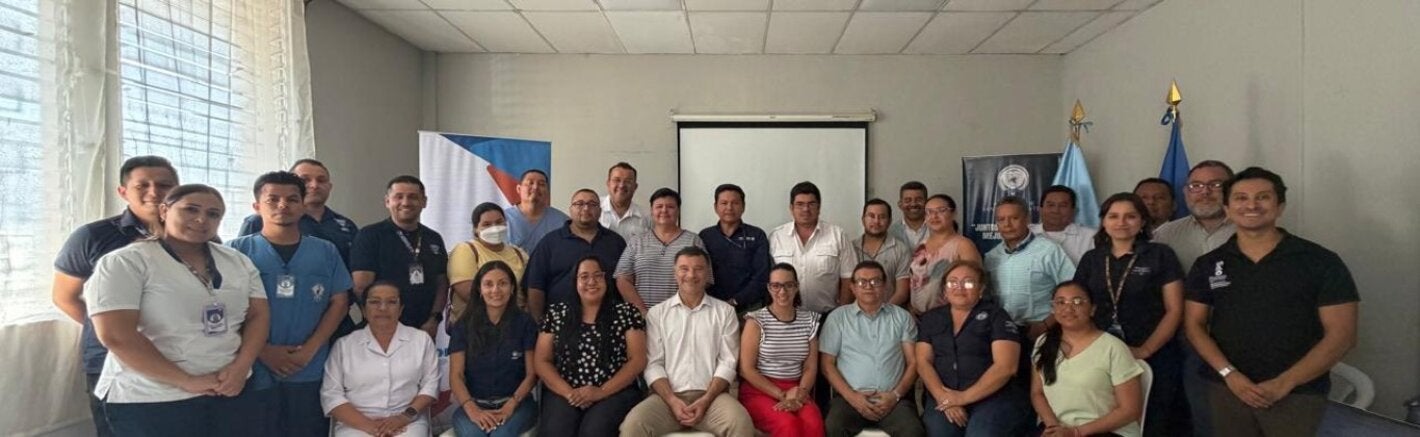
Approximately 30 professionals from hospitals in the western region, together with teams from the Ministry of Health, ANDRES, and the Santa Ana Centro Municipal Clinic, participated in a workshop promoted by PAHO/WHO with support from the Government of Canada to strengthen safety, quality of care, and local response within the framework of the elimination strategy.
Santa Ana, El Salvador, 17 April 2026 — Health professionals from the western region of the country participated in a capacity-building workshop on the safe management of bio-infectious waste, an initiative aimed at improving safety conditions in healthcare facilities and strengthening quality of care at the territorial level. The activity brought together around 30 participants from the San Juan de Dios Hospital in Santa Ana, Ahuachapán Hospital, Sonsonate Hospital, Metapán Hospital, Chalchuapa Hospital, and the Santa Ana Centro Municipal Clinic. It also included the participation of the Environmental Health Division of the Ministry of Health and the National Solid Waste Authority (ANDRES), thereby reinforcing an interinstitutional approach to a key issue for public health and environmental management.
One of the most notable aspects of the workshop was the participation of professionals from the National Women’s Hospital, who had been trained the previous year and, on this occasion, supported the training of healthcare teams from the Western Region. This helped ensure continuity of the process and strengthen capacities that can be replicated in other facilities across the country.
The workshop combined technical content, review of practical tools, and field-based work through visits to healthcare facilities, with the aim of enabling participating teams to adapt these learnings to the realities of their own institutions. The expectation is that this process will contribute to improving staff safety, the protection of patients and communities, and the quality of health services.
This initiative is part of the country’s efforts to advance the disease elimination strategy, particularly in relation to trachoma, where environmental conditions and proper waste management are part of a more comprehensive and sustainable response. At the same time, it aligns with the territorial work promoted by the Healthy Municipalities, Cities, and Communities network, which the Municipality of Santa Centro recently joined and through which it seeks to strengthen concrete capacities at the local level.
The Pan American Health Organization/World Health Organization (PAHO/WHO) also highlighted the support of the Santa Ana Centro Mayor’s Office, which provided the facilities for the workshop and promoted the participation of its municipal clinic, as well as the support of the Government of Canada, whose contribution has been key to advancing technical cooperation actions in environmental health.
The Ministry of Health continues to move forward in implementing the elimination roadmap, and PAHO/WHO supports this effort by strengthening capacities, promoting coordination among stakeholders, and supporting territorial responses that contribute to building safer, more resilient, and higher-quality care environments.