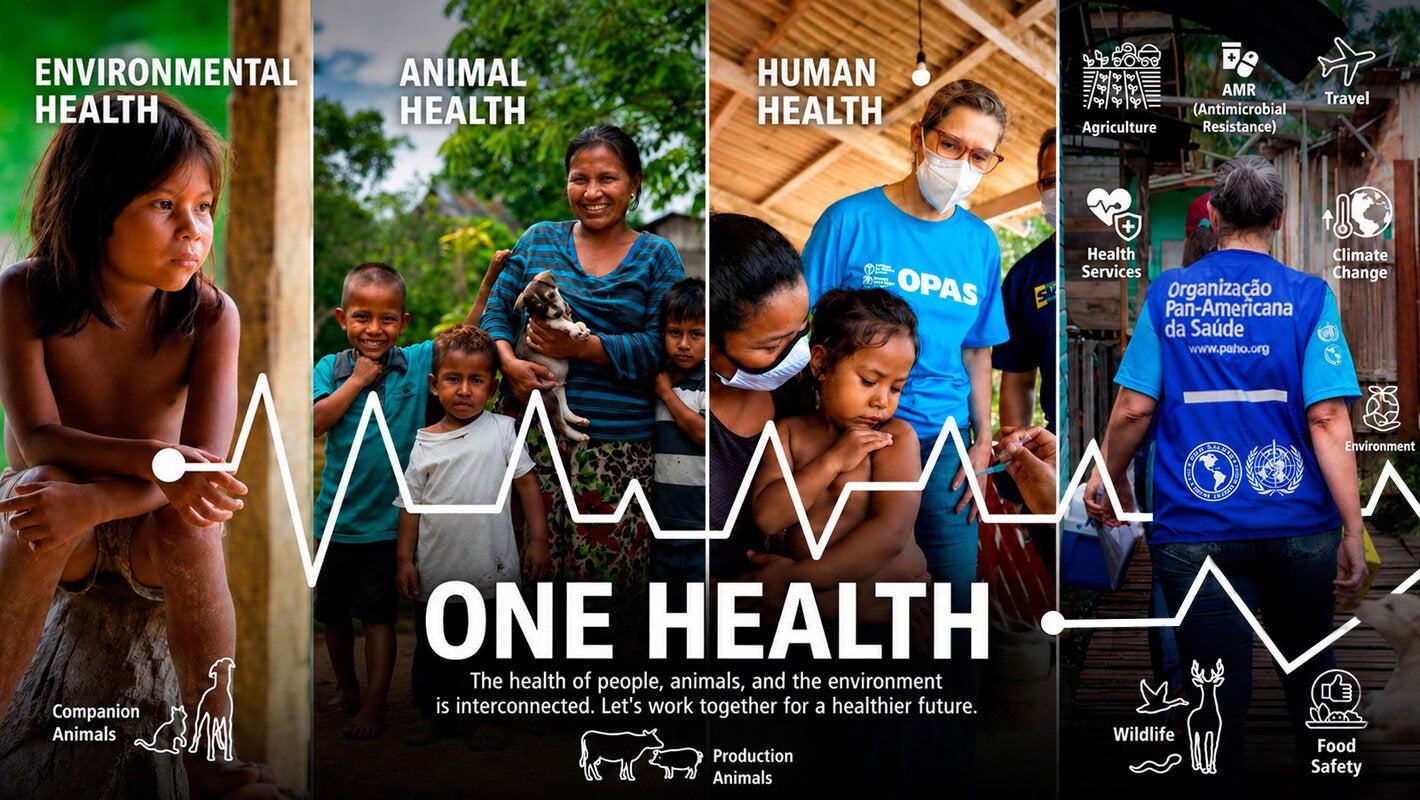
The initiative will strengthen coordination among the members of the global Quadripartite Alliance in the Americas (FAO, WOAH, PAHO/WHO, and UNEP) and regional partners (IICA and OIRSA) to work together and support countries in addressing health threats that simultaneously affect people, animals, plants, and the environment through the One Health approach.
July 6, 2026 (PANAFTOSA/VPH-PAHO/WHO) – Every July 6, the international community marks World Zoonoses Day to raise awareness about the risk of disease transmission between animals and humans and to promote measures to prevent zoonotic diseases.
Approximately 60% of known human infectious diseases are zoonotic in origin, while nearly 75% of emerging infectious diseases in humans originate from domestic or wild animals.
In addition, antimicrobial resistance (AMR) is estimated to cause 1.27 million direct deaths each year worldwide and is associated with nearly 5 million deaths annually. Foodborne diseases are responsible for 1.5 million deaths every year, including 78,000 in the Americas.
These figures underscore the need for an integrated, multisectoral approach to addressing these and other health threats by bringing together human health, animal health, and environmental conservation.
Against this backdrop, the Quadripartite Alliance—comprising the Food and Agriculture Organization of the United Nations (FAO), the World Organisation for Animal Health (WOAH), the Pan American Health Organization/World Health Organization (PAHO/WHO), and the United Nations Environment Programme (UNEP)—together with regional partners, the Inter-American Institute for Cooperation on Agriculture (IICA) and the International Regional Organization for Agricultural Health (OIRSA), today signed a Joint Declaration to strengthen their coordination under the One Health approach in the Americas.
The declaration calls for coordinated action to address health threats, including zoonotic diseases, food safety risks, and the impacts of climate change, biodiversity loss, environmental pollution, ecosystem degradation, and antimicrobial resistance.
"The health challenges faced by the region in recent years have highlighted the importance of strategic partnerships and joint action to achieve sustainable results, as demonstrated by our work to address avian influenza and New World screwworm in the region, helping to protect the livelihoods of thousands of farming families. By signing this declaration, we take another step toward strengthening regional cooperation and coordinated action to advance the implementation of One Health," said Rene Orellana Halkyer, FAO Assistant Director-General and Regional Representative for Latin America and the Caribbean.
"Animal health systems are a critical first line of defense against disease outbreaks, particularly those with pandemic potential. However, WOAH's latest State of the World's Animal Health report shows that these systems continue to be underfunded. The One Health approach can only reach its full potential if animal health is fully integrated into public planning and investment. In the Americas, WOAH has promoted this integrated approach for years, advocating for greater recognition of the role of animal health. This declaration marks a milestone for the region by reaffirming our commitment to addressing shared challenges more effectively," said Dr. Francisco D'Alessio, WOAH Regional Representative for the Americas.
The declaration highlights that the Americas have a strong history of intersectoral cooperation in public health, animal health, agriculture, and the environment. However, it also recognizes the need to further strengthen coordination among international organizations, governments, academia, civil society, and the private sector to effectively respond to current and future challenges.
"For PAHO, the One Health approach is a strategic priority and an essential component of public health in the Americas to address current and emerging health risks in an integrated manner. For decades, this approach has guided PAHO's technical cooperation through programs on communicable diseases at the human-animal interface, food safety, antimicrobial resistance, and environmental public health, particularly through the work of our Regional Center for Veterinary Public Health, PANAFTOSA, and through PAHO's One Health Policy, which this year marks five years of implementation," said Dr. Jarbas Barbosa, Director of PAHO.
For his part, Juan Bello, UNEP Regional Director and Representative for Latin America and the Caribbean, stated:
"For UNEP, the One Health approach is essential to addressing environmental and health challenges in Latin America and the Caribbean in an integrated manner by recognizing the close interconnection between human, animal and environmental health. In the face of planetary threats such as climate change, biodiversity loss, and pollution, One Health promotes the resilience of natural systems by prioritizing preventive rather than reactive actions from an environmental perspective. It also strengthens regional cooperation to address the environmental dimensions of antimicrobial resistance and reduce the risk of zoonotic diseases with pandemic potential, in line with the 2030 Agenda for Sustainable Development."
The objective of this Joint Declaration is to bring together organizations, networks, and key stakeholders to strengthen information sharing and regional collaboration. It also seeks to support the Member States of the Region in prioritizing and implementing actions through enhanced coordination, intersectoral collaboration, and the establishment of public-private partnerships in the areas of governance, legislative frameworks, organizational development, capacity building, and the exchange of data, evidence, and knowledge.
Through this declaration, the participating organizations reaffirm their commitment to promoting coordinated responses to health threats that transcend sectors and borders, contributing to the protection of the health of people, animals, and ecosystems throughout the Americas.